Data Masking in Elasticsearch
Organizations increasingly use Elasticsearch to store operational logs, application telemetry, customer records, and search data. While this flexibility accelerates analytics and search capabilities, it also creates significant risks when sensitive information becomes accessible to users who do not require full visibility.
Data masking in Elasticsearch helps organizations protect sensitive information while maintaining the usability of search results and analytical workloads. Proper masking strategies reduce the risk of exposing personally identifiable information (PII), financial records, healthcare data, and other confidential information.
Modern compliance frameworks such as GDPR, HIPAA, PCI DSS, SOX, and CCPA require organizations to implement appropriate controls that restrict unnecessary access to sensitive data. According to the OWASP Top 10, broken access control remains one of the most critical security risks affecting modern applications and data platforms.
As Elasticsearch deployments continue to grow across cloud, on-premises, and hybrid environments, masking has become a critical component of database security and compliance programs.
This article explores Elasticsearch data masking capabilities, common challenges, and how DataSunrise enhances Elasticsearch security through centralized masking, compliance automation, and intelligent policy management.
Importance of Data Masking
As organizations collect larger volumes of customer, financial, healthcare, and operational data, protecting sensitive information has become a fundamental security requirement. Elasticsearch often serves as a centralized repository for logs, analytics data, application records, and business information, making it a valuable target for both external attackers and insider threats.
Data masking helps organizations minimize exposure risks by ensuring that sensitive values remain protected even when users, applications, or third-party services access Elasticsearch indexes. Instead of displaying original values, masking techniques replace sensitive information with obfuscated or partially hidden data while preserving its usability for analytics, testing, and operational workflows.
Effective masking also plays a critical role in regulatory compliance. Frameworks such as GDPR, HIPAA, PCI DSS, and CCPA require organizations to limit access to sensitive information based on business necessity. By implementing data masking alongside access controls and security monitoring, organizations can reduce compliance risks while maintaining data accessibility for authorized users.
Beyond compliance, masking supports secure collaboration across development, testing, analytics, and support teams. Teams can work with realistic datasets without exposing actual customer information, reducing the likelihood of accidental disclosure or misuse.
Role-Based Access Controls
Elasticsearch supports role-based access control that allows administrators to define permissions for users and applications. Access can be limited to specific indexes, clusters, or operations.
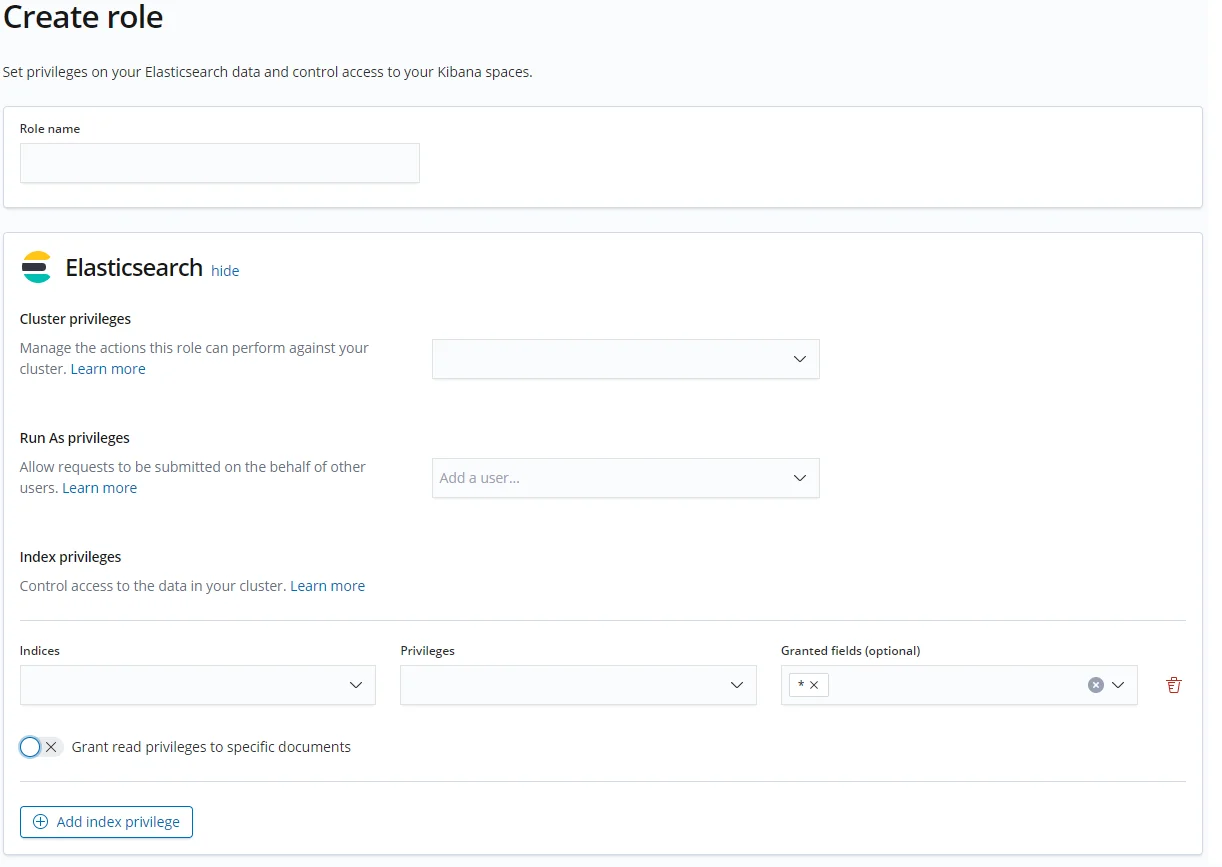
While useful for restricting access, RBAC does not provide dynamic masking of sensitive fields.
Field-Level Security
Organizations using advanced Elasticsearch security features can restrict access to selected fields.
Example:
{
  "indices": [
    {
      "names": [
        "customer_data"
      ],
      "privileges": [
        "read"
      ],
      "field_security": {
        "grant": [
          "customer_id",
          "customer_name",
          "order_date",
          "status",
          "region"
        ],
        "except": [
          "credit_card_number",
          "ssn",
          "salary"
        ]
      }
    }
  ]
}
This approach prevents visibility of specific fields but does not allow partial masking or context-aware protection.
Document-Level Security
Document-level security limits access to entire records based on defined criteria.
Example:
{
  "indices": [
    {
      "names": [
        "employee_records"
      ],
      "privileges": [
        "read"
      ],
      "query": {
        "bool": {
          "must": [
            {
              "term": {
                "department.keyword": "finance"
              }
            },
            {
              "term": {
                "status.keyword": "active"
              }
            }
          ]
        }
      }
    }
  ]
}
Although effective for segregation, this method cannot selectively mask portions of sensitive values.
DataSunrise Data Masking for Elasticsearch
DataSunrise provides comprehensive data masking capabilities for Elasticsearch that help organizations protect sensitive information without modifying existing applications, workflows, or business processes. The platform combines centralized policy management, automated sensitive data discovery, and real-time masking enforcement to reduce the risk of unauthorized data exposure.
Unlike native Elasticsearch security controls that primarily restrict access to entire documents or fields, DataSunrise enables granular masking of sensitive values while preserving data usability for authorized business operations. This approach allows organizations to maintain security, compliance, and operational efficiency simultaneously.
Step 1: Connect Elasticsearch to DataSunrise
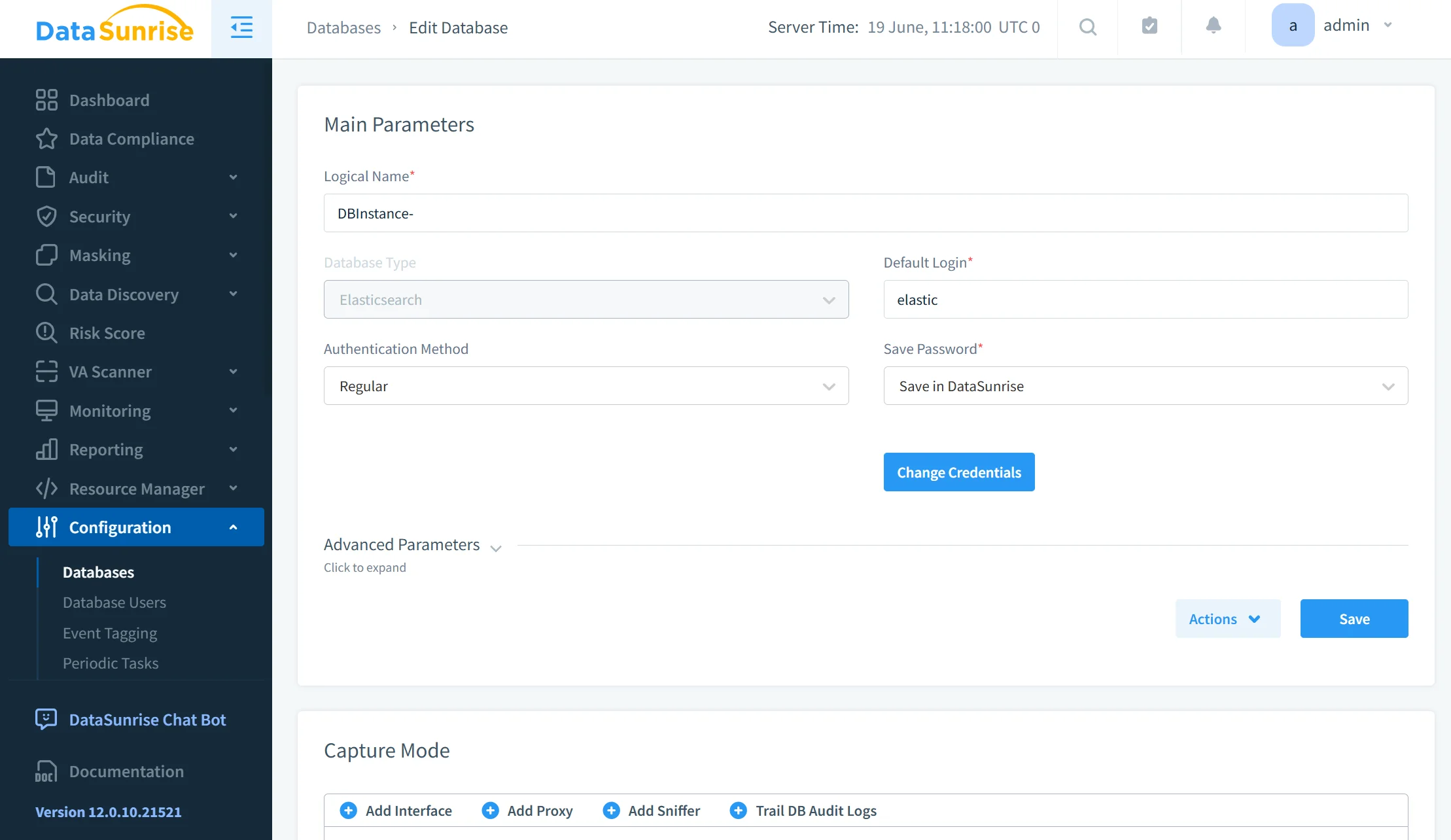
The first step is connecting the Elasticsearch environment to DataSunrise. The platform supports multiple deployment modes, allowing organizations to integrate security controls across cloud, on-premises, and hybrid infrastructures without requiring application changes or database modifications.
Once connected, DataSunrise can monitor data access requests and apply masking policies before sensitive information is displayed to end users.
Step 2: Discover Sensitive Data
Before masking policies can be applied, organizations must identify where sensitive information resides. DataSunrise automates this process using advanced data discovery technologies that scan Elasticsearch indexes and connected data sources for regulated and confidential information.
DataSunrise performs sensitive data discovery using multiple detection techniques. The platform automatically scans data repositories to identify personally identifiable information (PII), financial records, healthcare information, authentication credentials, and other regulated data types. Discovery mechanisms include natural language processing for contextual content analysis, optical character recognition for extracting sensitive information from image-based content, pattern recognition algorithms for identifying structured data formats, and built-in compliance templates aligned with major regulatory frameworks.
These capabilities support structured, semi-structured, and unstructured data across databases, data warehouses, cloud storage systems, enterprise repositories, and file systems.
Step 3: Create Dynamic Masking Policies
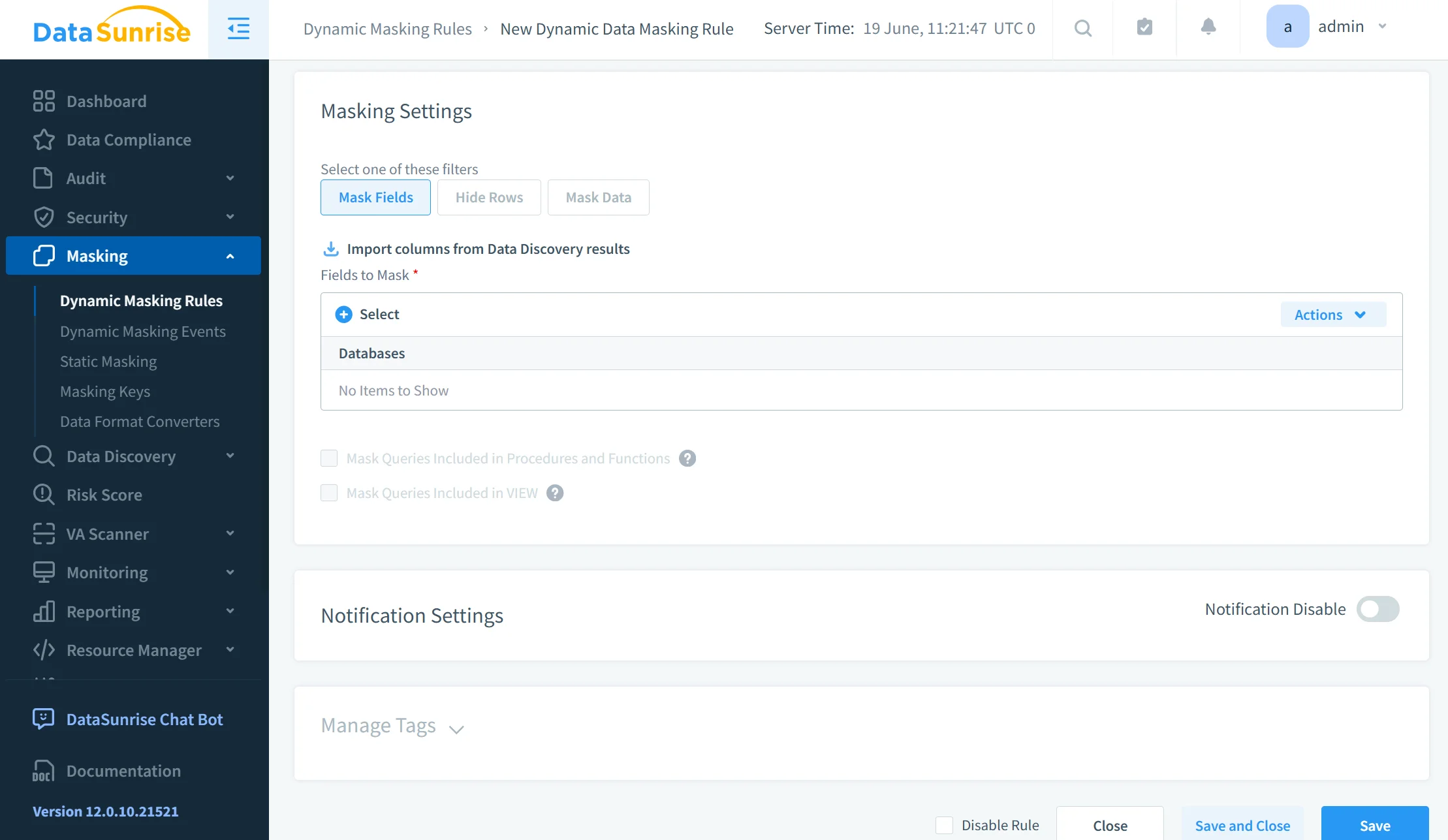
After discovering sensitive information, administrators can configure masking rules based on business and security requirements.
Masking policies can be customized according to user identity, user roles, application sources, client IP addresses, data categories, and specific regulatory requirements. This flexibility allows organizations to implement granular access controls that align with business processes and compliance obligations.
For example, customer service personnel may be permitted to view partially masked payment information, while compliance officers, auditors, or designated administrators retain access to original values when necessary.
Step 4: Enforce Policies Automatically
Once masking policies are configured, DataSunrise applies them automatically whenever protected Elasticsearch data is accessed.
The platform evaluates each request in real time and determines whether the requesting user should receive original values or masked content. Access decisions are based on the configured masking policies, user permissions, security context, and compliance requirements.
Authorized personnel continue to access unmodified information, while other users receive masked versions of sensitive data according to the applicable rules. This automated enforcement eliminates the need for manual intervention and ensures consistent protection across Elasticsearch environments.
As a result, organizations can reduce administrative effort, improve policy consistency, strengthen compliance through Compliance Manager and automated compliance reporting, and minimize the risk of unauthorized disclosure of sensitive information.
Elasticsearch Native Masking vs DataSunrise
| Capability | Native Elasticsearch | DataSunrise |
|---|---|---|
| Dynamic Data Masking | Limited | Full Support |
| Static Data Masking | No | Yes |
| Sensitive Data Discovery | Limited | Automated |
| Compliance Automation | Limited | Compliance Autopilot |
| Centralized Management | No | Unified Platform |
| Audit-Ready Reporting | Limited | Automated |
| User Behavior Analytics | Limited | ML-Powered |
| Multi-Environment Support | Elasticsearch Only | Cloud, On-Premises, Hybrid |
| Regulatory Compliance Support | Manual Configuration | GDPR, HIPAA, PCI DSS, SOX, CCPA |
| Administrative Effort | Higher | Reduced Through Automation |
This comparison highlights that Elasticsearch primarily provides access-control and security mechanisms, while DataSunrise extends protection through advanced dynamic and static masking, automated sensitive data discovery, centralized compliance management, detailed report generation, and intelligent behavior analytics. Together, these capabilities help organizations strengthen data protection, simplify compliance initiatives, and reduce the operational burden associated with securing Elasticsearch environments.
Conclusion
Elasticsearch provides valuable security controls through role-based access management, field-level restrictions, and document-level access controls. These capabilities establish a useful foundation for protecting sensitive information.
However, organizations operating under modern compliance requirements frequently need broader visibility, automated governance, centralized policy management, and more granular protection mechanisms.
DataSunrise enhances Elasticsearch data masking through advanced dynamic data masking, automated sensitive data discovery, intelligent compliance management, centralized database activity monitoring, and comprehensive security controls. The platform delivers protection across structured, semi-structured, and unstructured data while supporting cloud, on-premises, and hybrid environments through flexible deployment modes.
The result is an enterprise-ready platform that reduces compliance risk, streamlines security operations, accelerates audit preparation, and strengthens protection of sensitive information throughout Elasticsearch environments.
Learn more about DataSunrise's data masking capabilities, data compliance solutions, database activity monitoring, and deployment options, or schedule a live demo to see Data Masking in Elasticsearch in action.
Protect Your Data with DataSunrise
Secure your data across every layer with DataSunrise. Detect threats in real time with Activity Monitoring, Data Masking, and Database Firewall. Enforce Data Compliance, discover sensitive data, and protect workloads across 50+ supported cloud, on-prem, and AI system data source integrations.
Start protecting your critical data today
Request a Demo Download Now