Effortless Data Compliance for Elasticsearch
Modern Elasticsearch deployments ingest everything — logs, events, customer analytics, application traces, and unstructured documents. Much of this information contains sensitive fields that fall under GDPR, HIPAA, SOX, PCI DSS, and regional data-protection laws. Native Elasticsearch security features (see the official Elasticsearch documentation) provide basic audit logs, index-level access controls, and field-level restrictions, but they do not deliver automated classification, zero-touch masking, or continuous compliance alignment across clusters.
This guide explains Elasticsearch’s native compliance capabilities and demonstrates how DataSunrise delivers effortless, autonomous compliance across cloud, hybrid, and on-prem deployments.
Importance of Data Compliance
As organizations expand their Elasticsearch usage, compliance becomes more than a checkbox — it becomes a critical safeguard for operational continuity and regulatory accountability. Sensitive information often appears in deeply nested JSON structures, logs, and semi-structured payloads, making it difficult to detect and easy to expose. Regulations such as GDPR, HIPAA, and PCI DSS require strict control of personal and financial data, and violations carry significant legal and reputational consequences.
Without automated controls, Elasticsearch environments face drift and inconsistency as indices evolve, new fields appear, or applications change how they write data. Manual configuration cannot keep up with this pace, resulting in unauthorized exposure, misaligned access policies, and broken audit trails. Effective data compliance keeps Elasticsearch deployments secure, auditable, and aligned with evolving regulations — without compromising ingestion throughput or search performance.
DataSunrise achieves this through continuous discovery, automated remediation, and centralized governance.
Native Elasticsearch Compliance Capabilities
Elasticsearch includes several native features that support compliance and access governance, though all require continuous manual administration.
Audit Logging
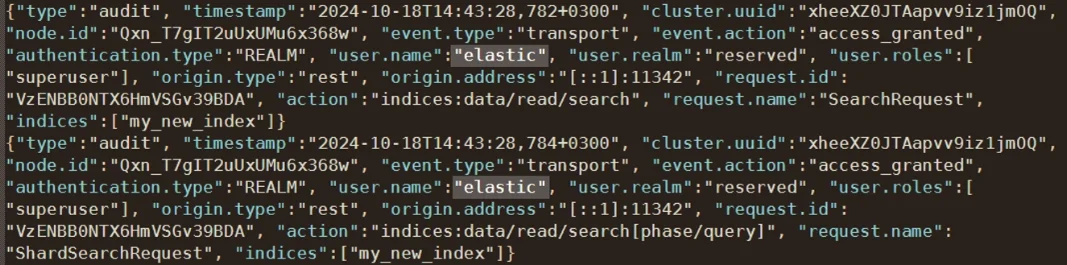
Elasticsearch audit logging (X-Pack Security) captures access attempts, document reads, authentication events, and administrative operations.
Enabling Native Audit Logging
xpack.security.audit.enabled: true
xpack.security.audit.logfile.events.include:
  - access_granted
  - access_denied
  - authentication_success
  - authentication_failed
xpack.security.audit.outputs: [ logfile ]
These logs help detect unauthorized activity but require manual parsing and do not provide automated classification or compliance alignment. Many organizations expand visibility using Database Activity Monitoring, Audit Logs, and Audit Trails from DataSunrise.
Role-Based Access Controls
Elasticsearch supports RBAC, Document-Level Security (DLS), and Field-Level Security (FLS), enabling granular document and field-level governance.
Example FLS policy:
{
  "indices": [
    {
      "names": [ "customers" ],
      "privileges": [ "read" ],
      "field_security": {
        "grant": [ "name", "status" ],
        "except": [ "credit_card", "ssn" ]
      }
    }
  ]
}
These native controls must be updated manually as data models evolve. DataSunrise strengthens governance through RBAC and Data Security Policies.
Effortless Data Compliance with DataSunrise
DataSunrise provides autonomous, zero-touch compliance for Elasticsearch using AI-driven discovery, dynamic masking, and continuous policy calibration — without requiring index changes or application rewrites.
1. Zero-Touch Sensitive Data Discovery
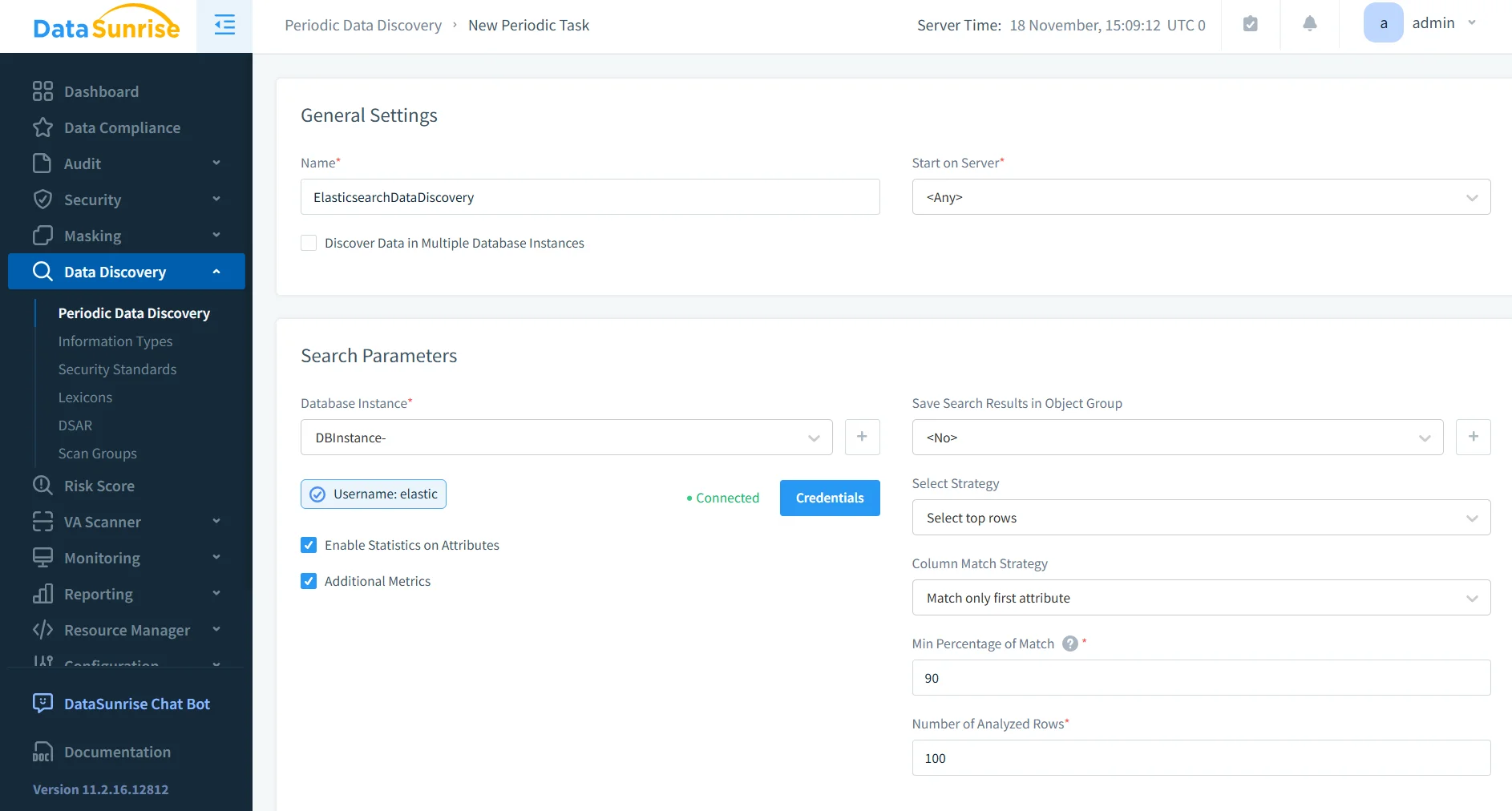
DataSunrise continuously scans Elasticsearch indices to detect sensitive information across structured and unstructured content. It identifies personal identifiers, financial and healthcare attributes, access tokens, credentials, and sensitive strings nested deep within JSON objects. NLP-powered detection enables recognition of sensitive fields even when naming conventions differ or data appears in free-form text.
Discovery requires no reindexing and operates seamlessly through proxy-mode, sniffer-mode, or log-trail integrations. These capabilities are powered by DataSunrise’s Data Discovery engine and PII Classification models.
2. Continuous Regulatory Calibration
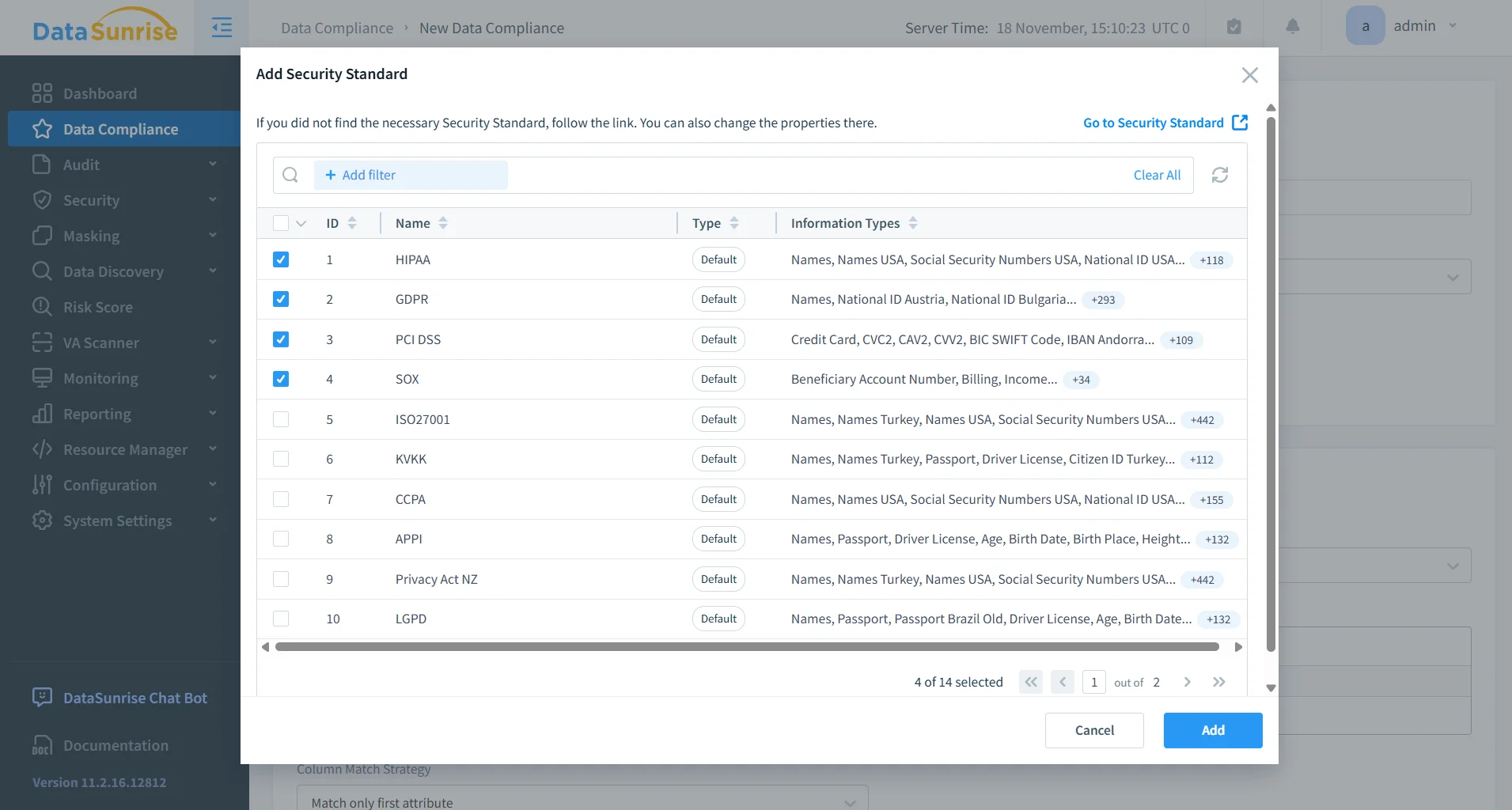
DataSunrise autonomously recalibrates compliance controls as Elasticsearch environments change. New fields and indices are automatically mapped to GDPR, HIPAA, PCI DSS, and SOX categories. ML-based audit rules adapt to emerging query patterns, and compliance drift is detected the moment new fields appear.
This regulatory alignment leverages the Compliance Manager and DataSunrise’s library of Compliance Regulations.
3. Real-Time Dynamic Masking for Elasticsearch
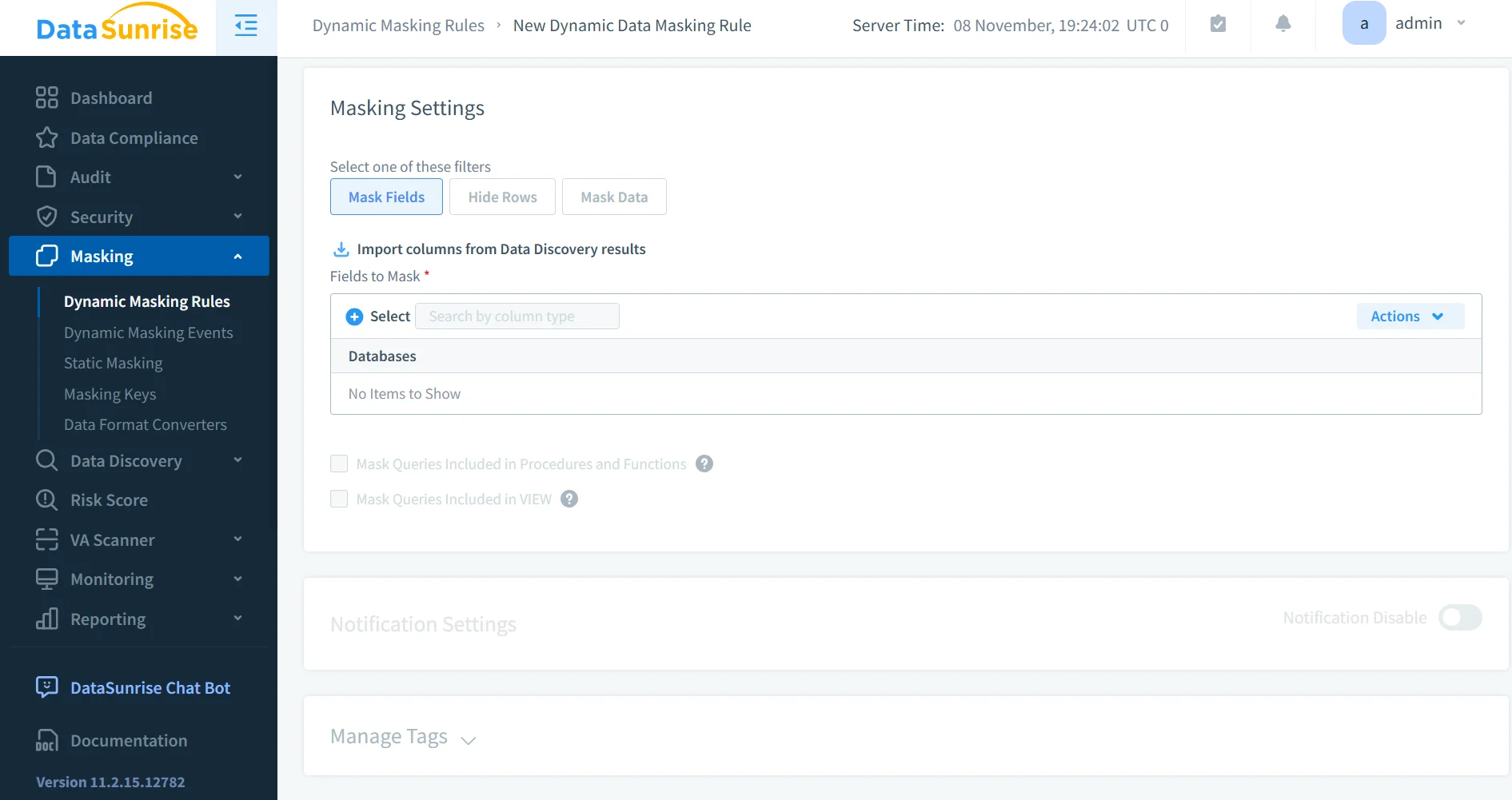
DataSunrise applies real-time dynamic masking to Elasticsearch query results without modifying stored data. Sensitive fields remain protected across search queries, bulk reads, analytics endpoints, and dashboards. Access rules adapt based on identity, privileges, query context, and application source.
Depending on the rule, DataSunrise applies redaction, tokenization, pseudonymization, or conditional masking. These protections are implemented using Dynamic Data Masking, Static Data Masking, and the broader Data Security framework.
Business Benefits (Comparison Table)
| Capability | Business Impact |
|---|---|
| 70%+ reduction in manual policy maintenance | Eliminates repetitive rule updates and reduces operational overhead |
| Autonomous protection for new sensitive fields | Prevents compliance drift during schema evolution |
| Unified auditing across deployments | Enhances visibility with centralized monitoring and reporting |
| Accelerated readiness for GDPR, HIPAA, SOX, PCI DSS | Simplifies audits using built-in regulatory evidence |
| Real-time prevention of sensitive-data exposure | Reduces breach risk across APIs, analytics, and dashboards |
| Lower compliance-related operational cost | Automation cuts manual labor and ongoing maintenance effort |
Supported by modules like the Audit Guide, Security Rules, and User Behavior Analytics.
Conclusion
Native Elasticsearch provides core audit and access tools, but modern distributed environments require adaptive, automated governance. DataSunrise delivers zero-touch protection, dynamic masking, sensitive-data discovery, drift detection, and regulator-aligned compliance — all without impacting indexing workloads or requiring application changes.
Organizations can further enhance governance using Deployment Modes and Data Audit capabilities across hybrid infrastructures.
Protect Your Data with DataSunrise
Secure your data across every layer with DataSunrise. Detect threats in real time with Activity Monitoring, Data Masking, and Database Firewall. Enforce Data Compliance, discover sensitive data, and protect workloads across 50+ supported cloud, on-prem, and AI system data source integrations.
Start protecting your critical data today
Request a Demo Download Now