How to Apply Data Governance for Amazon S3
Implementing robust data governance for Amazon S3 has become essential for modern enterprises. According to recent industry research, organizations with comprehensive S3 governance frameworks detect compliance violations 91% faster and reduce data breach costs by up to 68%.
Amazon S3 serves as the backbone for enterprise data lakes, application backends, and backup solutions. However, the flexibility and scale that make S3 attractive also introduce significant governance challenges—data sprawl, inconsistent access controls, and compliance difficulties across thousands of buckets.
This guide explores practical approaches to implementing effective data governance for Amazon S3, covering both native AWS capabilities and enhanced solutions that automate policy enforcement.
Understanding Data Governance for Amazon S3
Data governance for Amazon S3 encompasses the policies, procedures, and controls that ensure data is secure, compliant, discoverable, and properly managed throughout its lifecycle. Effective S3 governance addresses:
Data Classification and Discovery: Identifying sensitive data including PII, financial records, and regulated information through data discovery processes.
Access Control Management: Implementing appropriate permissions through IAM policies, bucket policies, and ACLs following least privilege principles.
Compliance Alignment: Meeting GDPR, HIPAA, PCI DSS, and SOX requirements through consistent compliance regulations enforcement.
Audit and Monitoring: Tracking data access and actions for security monitoring and compliance verification through database activity monitoring.
Lifecycle Management: Implementing retention policies and deletion procedures balancing operational needs with regulatory requirements.
S3's architecture introduces unique governance complexities: unstructured data at scale requiring intelligent classification, decentralized management creating policy inconsistencies, object-level permissions increasing configuration complexity, and cross-account access complicating audit trails.
Native AWS Capabilities for S3 Data Governance
Amazon Web Services provides several built-in tools for implementing data governance on S3:
1. S3 Bucket Policies and IAM
Configure access controls through bucket policies and IAM roles:
{
  "Version": "2012-10-17",
  "Statement": [
    {
      "Sid": "EnforceEncryptionInTransit",
      "Effect": "Deny",
      "Principal": "*",
      "Action": "s3:*",
      "Resource": "arn:aws:s3:::sensitive-data-bucket/*",
      "Condition": {
        "Bool": {"aws:SecureTransport": "false"}
      }
    }
  ]
}
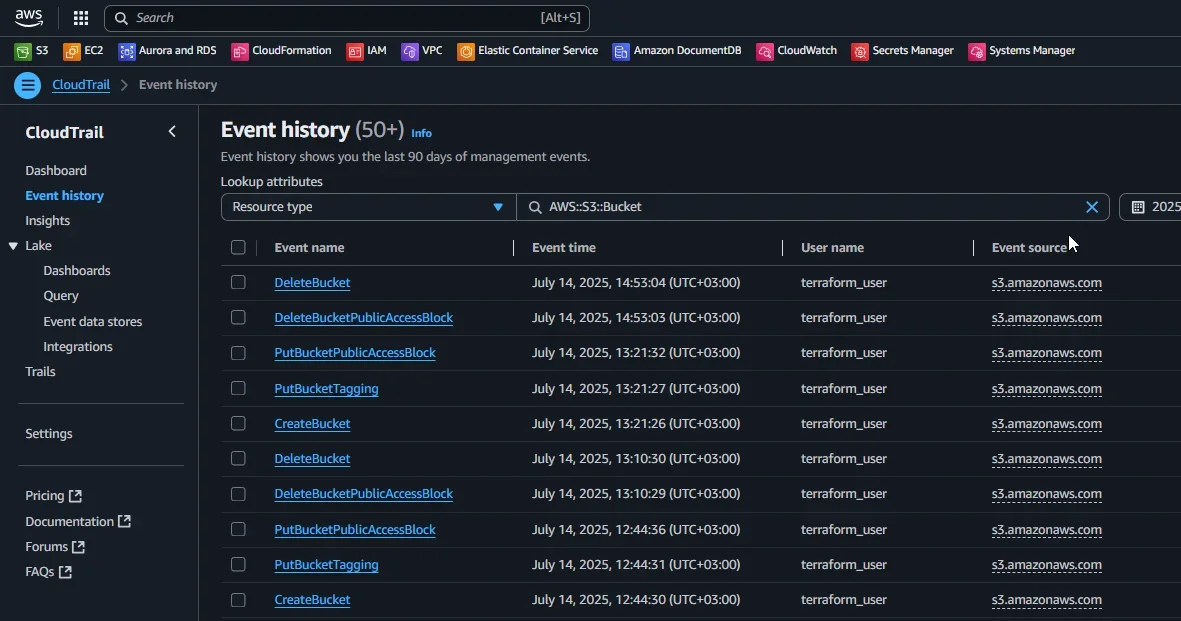
2. AWS CloudTrail
Enable CloudTrail to capture S3 data events for audit purposes:
aws cloudtrail create-trail \
  --name s3-governance-trail \
  --s3-bucket-name governance-audit-logs
While AWS provides essential governance capabilities, organizations often encounter limitations: complex JSON syntax requiring deep expertise, manual tagging processes creating incomplete coverage, and separate analysis tools needed for CloudTrail logs.
Enhanced S3 Data Governance with DataSunrise
DataSunrise significantly enhances Amazon S3 governance through Zero-Touch Data Protection and Autonomous Compliance Orchestration designed for cloud storage environments. Unlike basic tagging approaches, DataSunrise delivers enterprise-grade data security with comprehensive automation.
Implementing DataSunrise for Amazon S3 Governance
1. Connect to Amazon S3: Establish a secure connection to your AWS S3 buckets using IAM roles or access keys. DataSunrise supports cross-account access for comprehensive coverage.
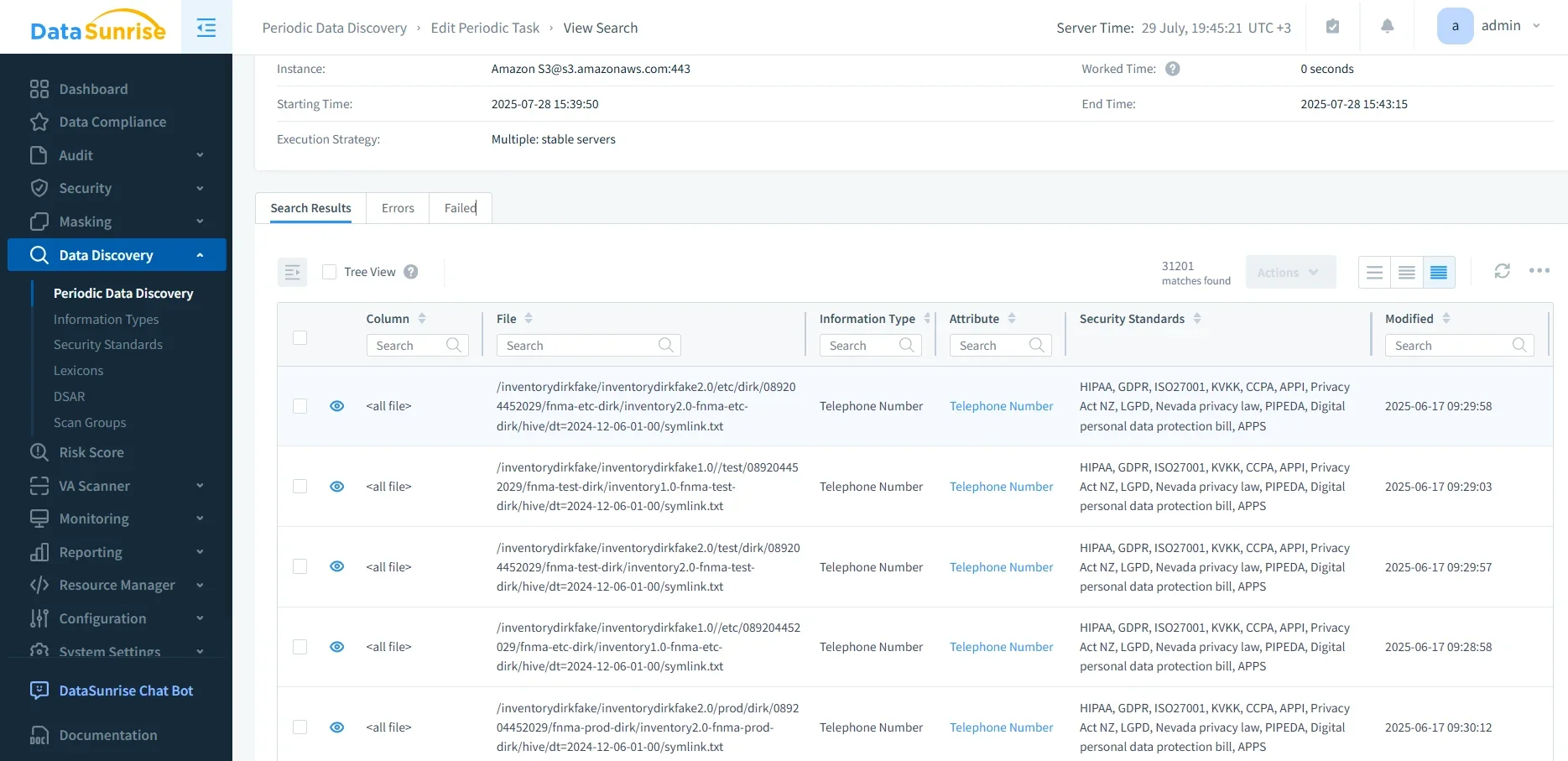
2. Auto-Discovery and Classification: Leverage NLP Data Discovery and OCR Image Scanning to automatically identify PII, PHI, and financial data across all objects. The Auto-Discover & Mask engine provides 95% greater coverage by analyzing file contents.
3. No-Code Policy Automation: Create governance policies without complex JSON—define access controls, enforce GDPR/HIPAA/PCI DSS/SOX requirements, and apply dynamic data masking through an intuitive interface.
4. Real-Time Monitoring: Enable Real-Time Notifications with User Behavior Analytics for immediate alerts on unauthorized access and anomalies.
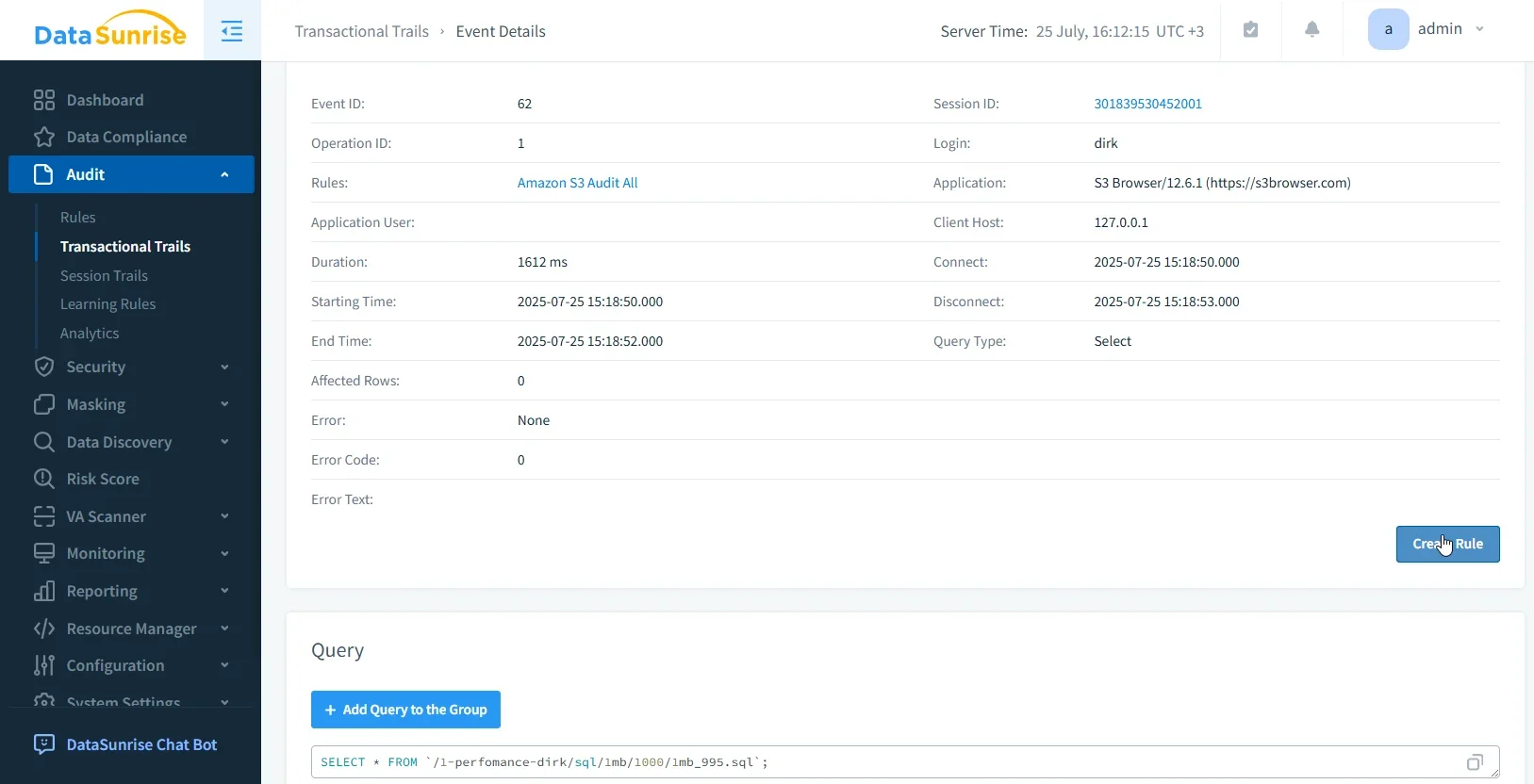
5. Automated Compliance Reports: Generate one-click audit-ready reports for regulatory frameworks with complete audit trails and compliance reporting dashboards.
Key Advantages of DataSunrise for Amazon S3
Comprehensive Sensitive Data Detection: Unlimited scanning with predictable pricing, supporting structured, semi-structured, and unstructured data formats.
Intelligent Policy Orchestration: Eliminates complex JSON, ensures consistency across accounts, and adapts automatically to changing requirements with data security policies.
Cross-Platform Governance: Monitor S3 alongside traditional databases and data warehouses with support for over 40 platforms.
Continuous Compliance Alignment: Automatic policy updates when regulations change with proactive compliance gap identification through compliance management.
Advanced Threat Detection: ML Suspicious Behavior Detection and UEBA monitoring identify unusual access patterns, security threats, and potential data exfiltration attempts.
Best Practices for Amazon S3 Data Governance
| Best Practice | Implementation | Key Benefit |
|---|---|---|
| Classification-First Strategy | Begin with comprehensive data discovery. Use DataSunrise's Auto-Discovery to continuously classify new objects and implement consistent tagging strategies. | Ensures governance policies apply immediately to all sensitive data |
| Least Privilege Access | Audit existing permissions and implement role-based access controls. Monitor access patterns and enforce MFA for sensitive data. | Reduces attack surface and prevents unauthorized data access |
| Comprehensive Audit Trails | Enable detailed audit logs for all data access events. Centralize log storage and use DataSunrise's analytics for actionable intelligence. | Provides complete visibility for security investigations and compliance |
| Data Lifecycle Management | Define retention policies based on classification and regulatory mandates. Automate transitions and deletions while implementing legal hold capabilities. | Ensures compliance with retention requirements and reduces storage costs |
| Encryption and Masking | Require encryption for sensitive data and apply data masking for non-production access. Monitor encryption compliance regularly. | Protects data at rest, in transit, and during access |
| Enhanced Governance Platform | Deploy DataSunrise with Zero-Touch Data Masking and Autonomous Compliance Orchestration. Leverage flexible deployment options to scale seamlessly. | Addresses native AWS limitations with automated policy enforcement |
Conclusion
As organizations increasingly rely on Amazon S3 for business-critical data, implementing robust data governance has become essential for security and compliance. While AWS provides foundational capabilities through IAM, bucket policies, and CloudTrail, organizations with complex requirements benefit from enhanced solutions providing Zero-Touch Compliance Automation and Intelligent Policy Orchestration.
DataSunrise transforms S3 data governance from a manual, reactive process into an automated, proactive security framework. By combining Auto-Discover & Classify capabilities with No-Code Policy Automation, DataSunrise enables organizations to achieve comprehensive visibility, enforce consistent policies, meet regulatory requirements with one-click reporting, and detect threats faster.
Protect Your Data with DataSunrise
Secure your data across every layer with DataSunrise. Detect threats in real time with Activity Monitoring, Data Masking, and Database Firewall. Enforce Data Compliance, discover sensitive data, and protect workloads across 50+ supported cloud, on-prem, and AI system data source integrations.
Start protecting your critical data today
Request a Demo Download Now