MongoDB Regulatory Compliance
Organizations that rely on MongoDB must align database operations with strict industry regulations such as GDPR, HIPAA, and PCI DSS. Regulatory compliance ensures sensitive information is handled properly while maintaining customer trust and avoiding costly penalties.
MongoDB includes native security features like auditing, authentication, and role-based access control. However, native functionality often requires manual oversight and may not provide the centralized automation modern enterprises expect. This is where advanced compliance solutions such as DataSunrise Compliance Manager strengthen MongoDB environments by introducing automation, audit-ready reporting, and intelligent enforcement.
In addition, regulators are enforcing stricter controls on data usage across industries. According to Gartner research, organizations face increasing fines for non-compliance, highlighting the urgent need for robust governance. MongoDB users in sectors like healthcare, finance, and government must therefore implement compliance measures as part of daily database operations. You can also explore detailed data security practices and recommendations from MongoDB Security Documentation to better understand native options.
Importance of Regulatory Compliance
Meeting regulatory requirements is more than a legal obligation — it directly impacts operational security and customer trust. Without a proper compliance framework, MongoDB databases risk becoming a weak point for breaches, insider misuse, or audit failures.
Key reasons why regulatory compliance matters for MongoDB include:
- Legal Protection – Non-compliance with standards such as GDPR or HIPAA can result in heavy fines.
- Operational Integrity – Ensures only authorized users can access or modify sensitive collections.
- Audit Readiness – Maintaining complete audit trails simplifies inspections by regulators.
- Customer Confidence – Transparent data protection practices help retain user trust.
A recent KPMG survey highlighted that enterprises face growing challenges in balancing innovation with compliance, showing how critical enforcement has become worldwide.
Native MongoDB Compliance Capabilities
MongoDB supports several compliance-oriented features that help administrators align with common regulatory standards:
Auditing
MongoDB Enterprise provides a robust audit log facility that records key database events such as logins, role changes, and CRUD operations. This allows administrators to trace user activity and prove compliance during audits.
Example: Configuring Audit Logging in mongod.conf
auditLog:
  destination: file
  format: JSON
  path: /var/log/mongodb/auditLog.json
  filter: '{ atype: { $in: ["authenticate", "createUser", "dropUser", "updateRole", "insert", "update", "delete"] } }'
This configuration writes a JSON-formatted audit log to a file, capturing user authentication attempts and key data operations.
Authentication and Authorization
MongoDB supports multiple authentication mechanisms, including SCRAM, x.509 certificates, and LDAP integration. Combined with RBAC (Role-Based Access Control), administrators can enforce fine-grained access control at the database, collection, or cluster level.
Example: Enabling SCRAM Authentication
Start the MongoDB instance with authentication enabled:
mongod --auth --port 27017 --dbpath /var/lib/mongo
Then create an administrative user:
use admin
db.createUser({
  user: "adminUser",
  pwd: "StrongPassw0rd!",
  roles: [ { role: "userAdminAnyDatabase", db: "admin" } ]
})
Once enabled, all clients must authenticate before executing operations.
Encryption
MongoDB provides encryption both at rest and in transit. Data at rest can be protected by enabling WiredTiger encryption, while TLS/SSL secures client-server communication.
Example: Enabling Encryption at Rest
In mongod.conf:
storage:
  dbPath: /var/lib/mongo
  wiredTiger:
    engineConfig:
      encryption:
        enableEncryption: true
        encryptionKeyFile: /etc/mongodb-keyfile
Example: Enforcing TLS/SSL for Connections
net:
  ssl:
    mode: requireSSL
    PEMKeyFile: /etc/ssl/mongodb.pem
This ensures all network communication is encrypted and compliant with security standards.
Activity History
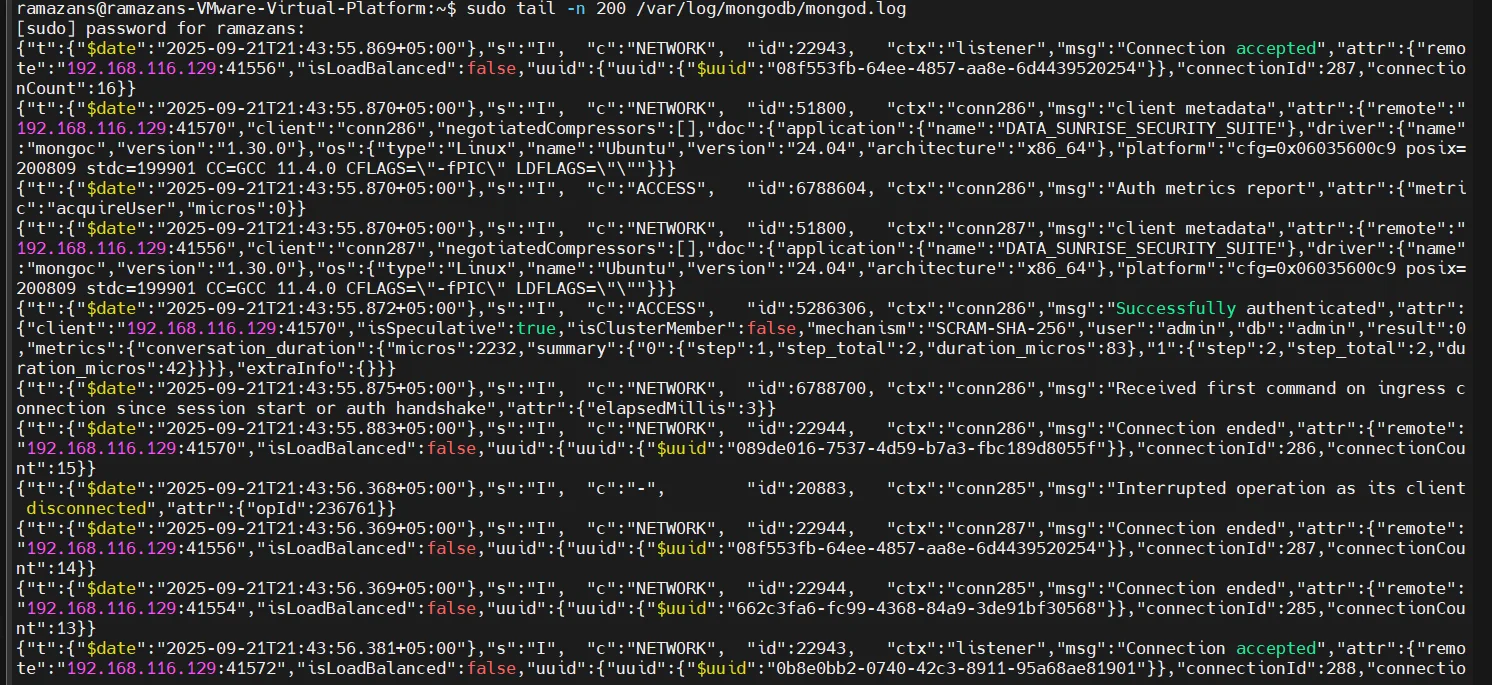
MongoDB logs can be directed to syslog or JSON files for external monitoring and compliance review. This allows integration with SIEM tools for long-term storage and regulatory audits.
Example: Sending Logs to Syslog
In mongod.conf:
systemLog:
  destination: syslog
  logAppend: true
  component:
    accessControl: { verbosity: 1 }
    network: { verbosity: 1 }
This configuration forwards access and network-related events to syslog, ensuring they are retained for compliance investigations.
Limitations of Native MongoDB Compliance Features
While MongoDB’s auditing and security functions provide a baseline, they have notable limitations:
- Manual Rule Setup – Audit filters must be defined and maintained by administrators.
- Scattered Controls – Logs and access rules are configured per instance, complicating multi-cluster environments.
- Performance Overhead – Fine-grained auditing can impact performance under heavy workloads.
- Limited Reporting – Audit logs require custom parsing or third-party tools to transform raw data into compliance-ready reports.
These constraints highlight the need for more centralized, automated compliance solutions.
Enhanced MongoDB Compliance with DataSunrise
DataSunrise extends MongoDB’s native capabilities by introducing automation, unified monitoring, and advanced compliance reporting. It operates transparently in proxy or sniffer mode, ensuring zero-touch integration without intrusive configuration changes.
Compliance Autopilot
The Compliance Autopilot automatically enforces rules for GDPR, HIPAA, PCI DSS, and SOX whenever new users or collections are created. Administrators no longer need to manually update policies after every schema or role change. Continuous regulatory calibration ensures MongoDB remains aligned with evolving global frameworks in real time. This reduces compliance drift and ensures audit-readiness at all times.
- Automatically detects schema changes and applies relevant compliance controls.
- Enforces consistent security policies across all MongoDB clusters.
- Reduces human error by eliminating the need for manual configuration updates.
- Ensures real-time adjustments to meet updated regulatory requirements.
Granular Audit Trails
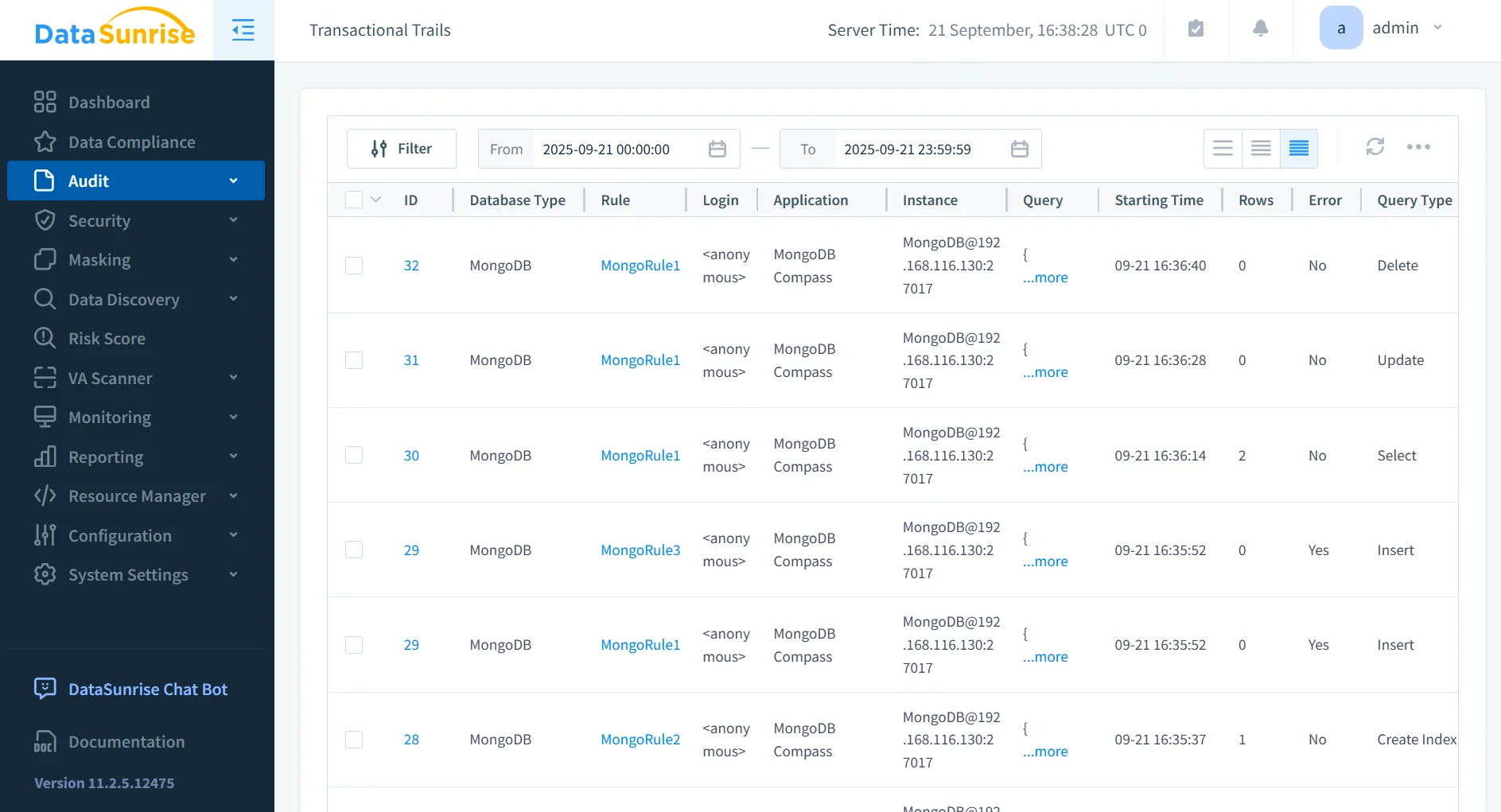
DataSunrise maintains granular audit trails across all MongoDB collections and clusters. Unlike basic native logs, these audit trails are enriched with contextual details such as user roles, query type, and session identifiers. Administrators can generate one-click compliance evidence tailored for regulators, drastically reducing the manual effort spent on preparing audit reports.
Dynamic Data Masking
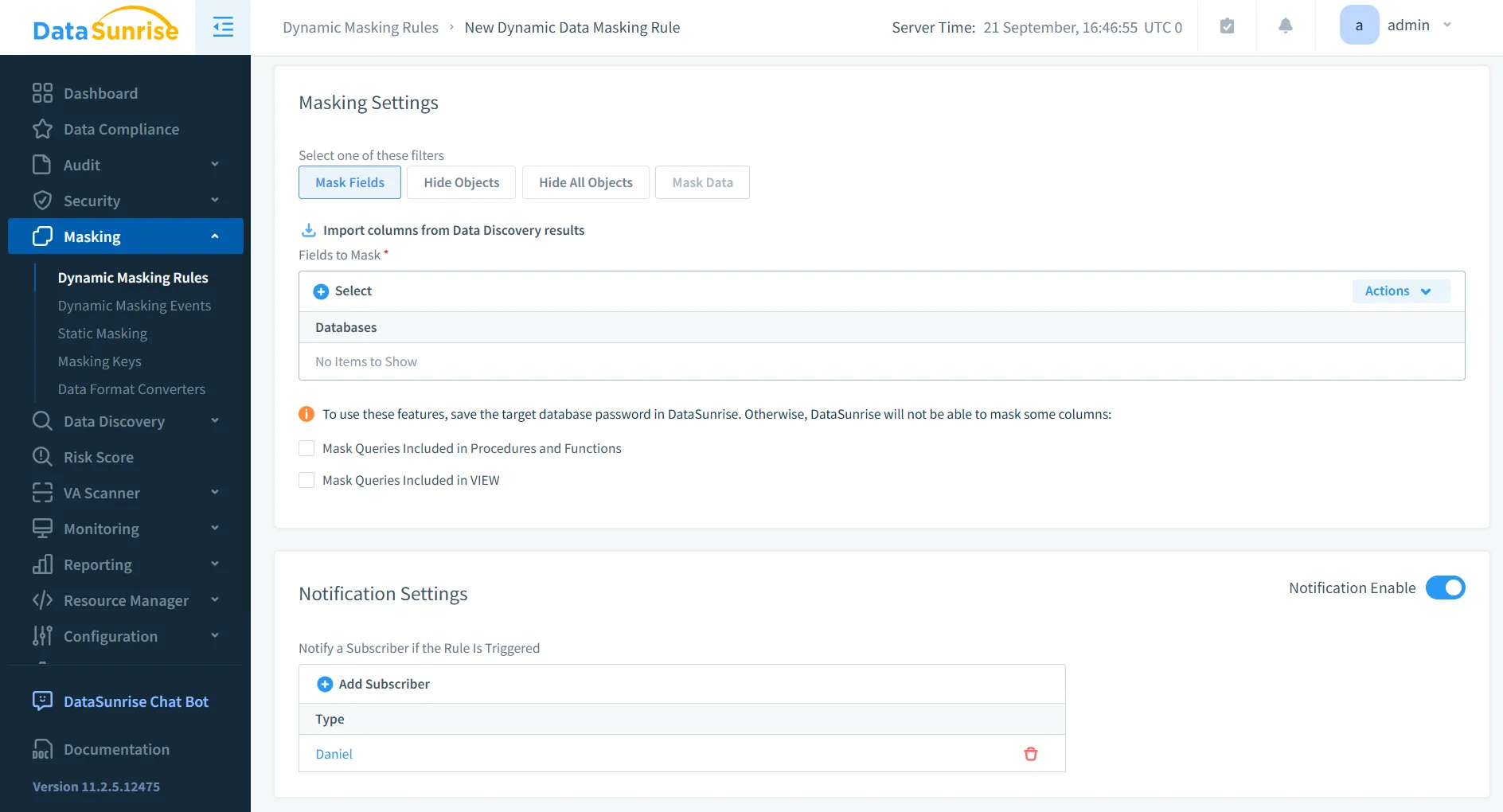
With dynamic data masking, sensitive MongoDB fields such as personally identifiable information (PII) or payment card data can be masked in real time. Access rules can be applied based on roles, user groups, or query conditions. This ensures that developers, analysts, or contractors only see obfuscated data while authorized users continue to access full records — achieving compliance with privacy laws without disrupting operations.
Centralized Monitoring
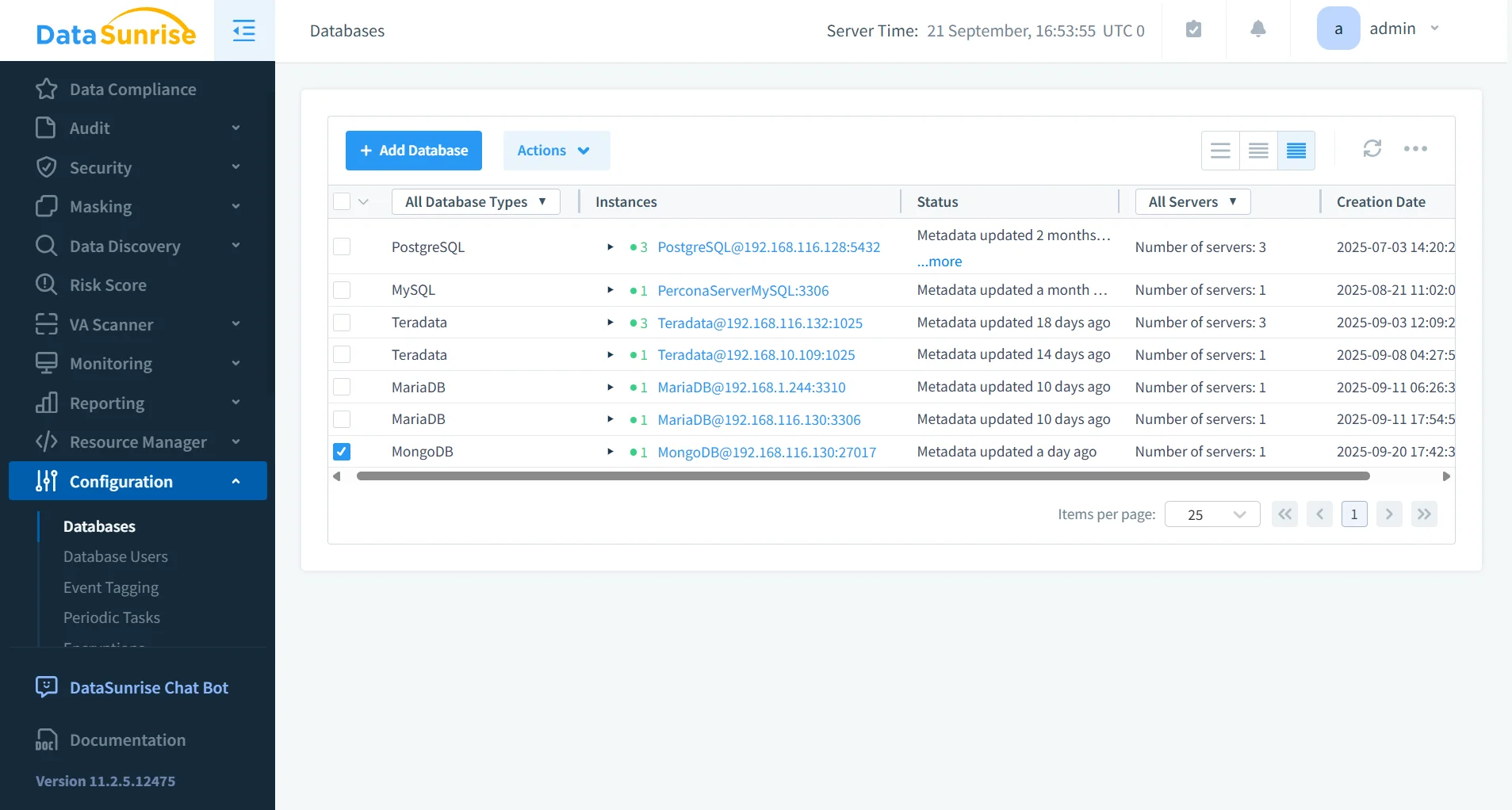
With centralized database activity monitoring, DataSunrise unifies compliance oversight across MongoDB and 40+ other platforms. Administrators can enforce policies consistently, view real-time notifications, and analyze activity logs from a single dashboard. This consolidation eliminates the overhead of managing separate compliance controls across multiple databases and environments.
Automated Compliance Reporting
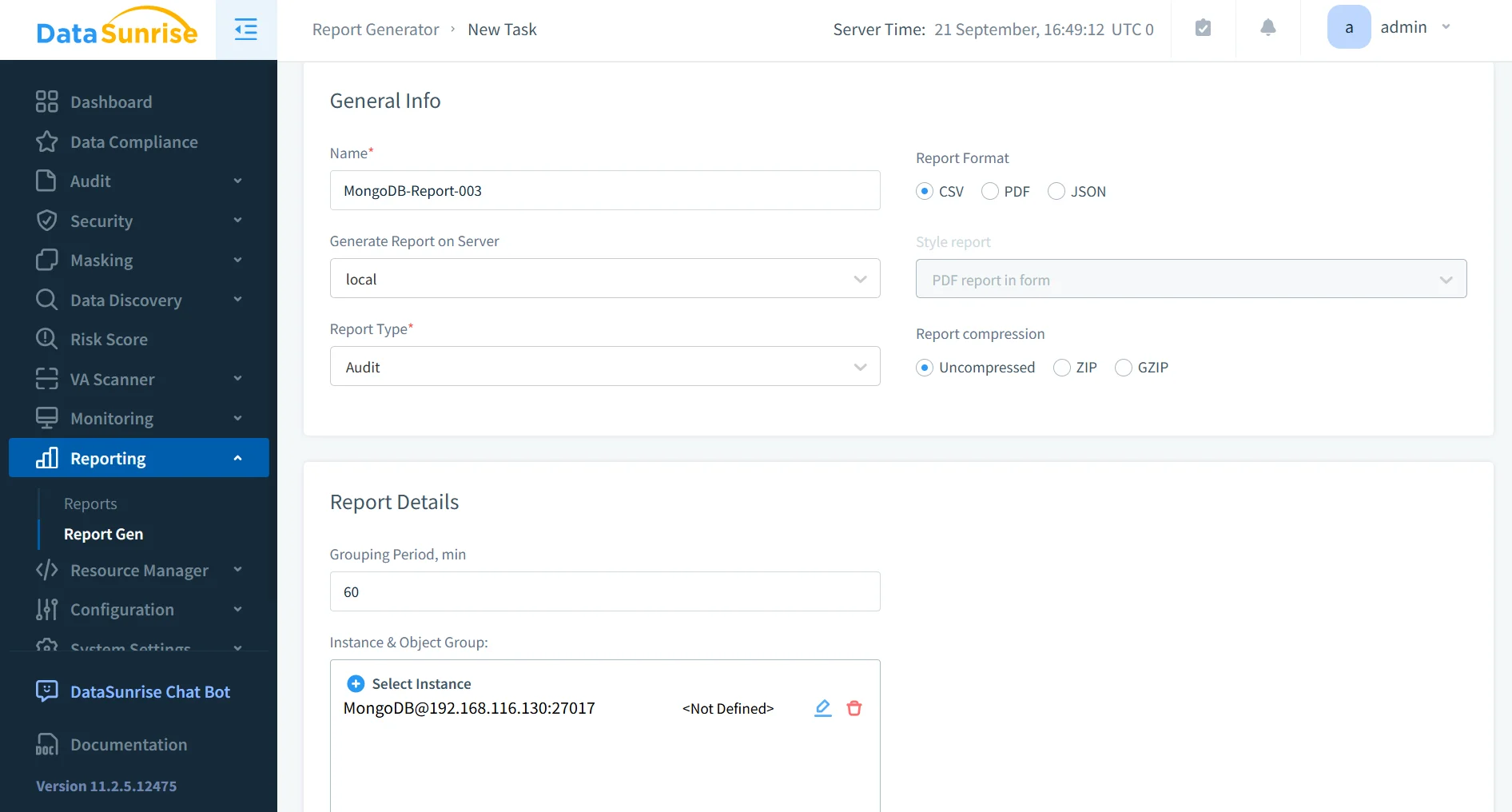
Automated compliance reporting allows MongoDB administrators to generate audit-ready documentation for frameworks such as GDPR, HIPAA, PCI DSS, and SOX in minutes. Reports can be scheduled or created on demand, covering access history, masking policies, and detected violations. This functionality drastically reduces the manual workload of compliance officers and ensures continuous readiness for external inspections.
Behavior Analytics
DataSunrise applies behavior analytics to MongoDB environments, correlating access patterns with machine learning insights. For example, if a user normally queries only customer support data but suddenly begins exporting entire collections, the system flags this anomaly instantly. Such detection is crucial for identifying insider threats, compromised accounts, or unauthorized access attempts.
- Monitors session behavior in real time to detect anomalies.
- Correlates queries with user roles and historical access patterns.
- Flags unusual data exports or privilege escalations immediately.
- Supports integration with notification systems like Slack or email for rapid incident response.
Business Impact of MongoDB Compliance with DataSunrise
Adopting DataSunrise for MongoDB regulatory compliance offers clear business advantages:
| Benefit | Impact |
|---|---|
| Risk Mitigation | Continuous monitoring and automated policy enforcement reduce exposure to database threats. |
| Audit Efficiency | One-click compliance reporting simplifies audits and inspections. |
| Operational Agility | No-code policy automation reduces admin workload and accelerates compliance tasks. |
| Trust and Reputation | Demonstrating strong compliance management builds customer and partner confidence. |
| Cost Reduction | Streamlined workflows lower the total cost of compliance. |
Conclusion
MongoDB’s native compliance features provide essential auditing, encryption, and RBAC support. However, in complex environments, these capabilities alone may fall short of enterprise needs.
By integrating DataSunrise Compliance Manager, organizations gain centralized control, automation, and regulatory alignment across MongoDB and other platforms. With features like Compliance Autopilot, dynamic masking, and intelligent behavior analytics, DataSunrise ensures MongoDB environments remain audit-ready and fully compliant.
Protect Your Data with DataSunrise
Secure your data across every layer with DataSunrise. Detect threats in real time with Activity Monitoring, Data Masking, and Database Firewall. Enforce Data Compliance, discover sensitive data, and protect workloads across 50+ supported cloud, on-prem, and AI system data source integrations.
Start protecting your critical data today
Request a Demo Download Now