Amazon DocumentDB Compliance Management
Organizations that use Amazon DocumentDB to store business-critical or regulated information must continuously verify that their databases comply with internal security policies and external regulations. Effective data compliance management extends beyond protecting infrastructure. It requires organizations to monitor database activity, discover sensitive data, validate security controls, maintain audit evidence, and respond quickly to configuration changes that could introduce compliance risks.
As regulatory frameworks continue to evolve, maintaining compliance manually becomes increasingly difficult. According to the IBM Cost of a Data Breach Report, organizations with mature security automation experience substantially lower breach costs and faster incident containment than those relying on manual processes. Automated compliance management helps reduce operational overhead while improving regulatory readiness. Organizations pursuing standards such as NIST SP 800-53 increasingly rely on continuous monitoring and automated security controls to maintain compliance.
Amazon DocumentDB provides native AWS services that help organizations establish secure database environments. Services such as AWS IAM, AWS Config, CloudTrail, CloudWatch, AWS Backup, Security Hub, and Amazon VPC support access control, logging, infrastructure monitoring, and configuration management. Together, these capabilities provide an important foundation for compliance initiatives and complement broader Database Activity Monitoring strategies.
However, managing compliance across growing cloud environments often requires more than infrastructure controls alone. Organizations must continuously identify sensitive information, detect policy drift, automate compliance validation, maintain centralized visibility, and produce audit-ready evidence for multiple regulatory frameworks.
This article explains how Amazon DocumentDB supports compliance management using native AWS services and demonstrates how DataSunrise automates compliance operations through continuous monitoring, intelligent policy orchestration, and centralized governance.
What is Amazon DocumentDB Compliance Management?
Amazon DocumentDB compliance management is the ongoing process of ensuring that DocumentDB environments continuously satisfy organizational security policies and applicable regulatory requirements throughout the database lifecycle. Unlike one-time compliance assessments, compliance management focuses on maintaining regulatory alignment as infrastructure, users, applications, and data evolve through continuous database activity monitoring, policy enforcement, and governance.
Effective compliance management combines multiple operational activities, including:
- identifying sensitive and regulated information
- enforcing least-privilege access policies
- monitoring database activity
- validating encryption and network security
- detecting configuration drift
- collecting audit evidence
- generating compliance reports
- supporting continuous regulatory assessments
Many organizations automate these processes using technologies such as Sensitive Data Discovery to identify regulated information and centralized compliance platforms that continuously monitor security posture across database environments.
For organizations subject to regulations such as GDPR, HIPAA, PCI DSS, SOX, CCPA, or ISO 27001, these activities must operate continuously rather than only during periodic audits. Continuous validation, automated reporting, and Compliance Manager capabilities help organizations maintain ongoing regulatory alignment while reducing manual effort.
Native Amazon DocumentDB Compliance Management
Amazon DocumentDB integrates with numerous AWS security and governance services that help organizations establish and maintain compliant database environments. Rather than providing a dedicated compliance management platform, Amazon DocumentDB relies on the broader AWS ecosystem to secure infrastructure, monitor configuration changes, protect stored data, and collect operational evidence for audits. Together, these services support identity management, encryption, continuous monitoring, logging, configuration assessment, backup validation, and overall security posture management throughout the database lifecycle.
Identity and Access Control
Identity management forms the first layer of compliance management. Amazon DocumentDB integrates with AWS Identity and Access Management (IAM) to control administrative access to clusters and associated AWS resources. Administrators can enforce least-privilege permissions, implement role separation, and restrict infrastructure changes through IAM policies, while database authentication remains managed separately inside Amazon DocumentDB. This separation allows organizations to control infrastructure administration and database access independently, improving security and supporting regulatory access governance.
The following IAM policy limits users to viewing cluster and instance information:
{
  "Version": "2012-10-17",
  "Statement": [
    {
      "Effect": "Allow",
      "Action": [
        "docdb:DescribeDBClusters",
        "docdb:DescribeDBInstances"
      ],
      "Resource": "*"
    }
  ]
}
Applying granular IAM permissions helps organizations reduce administrative risk while supporting compliance requirements related to access governance.
Encryption and Data Protection
Most regulatory frameworks require organizations to protect sensitive information both at rest and in transit. Amazon DocumentDB encrypts storage volumes using AWS Key Management Service (AWS KMS), protecting database storage, automated backups, manual snapshots, and storage replicas from unauthorized access. Client connections should also enforce Transport Layer Security (TLS) to secure communications between applications and DocumentDB clusters.
The following example connects to an Amazon DocumentDB cluster using TLS encryption:
mongo \
  --host sample-cluster.cluster-xxxxxxxx.us-east-1.docdb.amazonaws.com:27017 \
  --tls \
  --tlsCAFile global-bundle.pem \
  --username admin
Although encryption is a fundamental compliance requirement, it primarily protects data confidentiality. It does not provide visibility into how authorized users access sensitive information after successfully connecting to the database.
Continuous Configuration Assessment
AWS Config continuously evaluates Amazon DocumentDB resources against predefined compliance rules, allowing organizations to detect configuration drift before it creates security or regulatory issues. Administrators can automatically verify that encryption remains enabled, automated backups are configured correctly, deletion protection is active, approved network settings are maintained, security groups follow corporate policies, and parameter groups remain compliant.
The following AWS CLI command retrieves the current configuration state of an Amazon DocumentDB cluster:
aws docdb describe-db-clusters \
  --db-cluster-identifier sample-cluster \
  --query "DBClusters[0].{
    StorageEncrypted:StorageEncrypted,
    BackupRetentionPeriod:BackupRetentionPeriod,
    DeletionProtection:DeletionProtection,
    VpcSecurityGroups:VpcSecurityGroups
  }"
Administrators can also review AWS Config compliance results for DocumentDB resources:
aws configservice get-compliance-details-by-resource \
  --resource-type AWS::RDS::DBCluster \
  --resource-id sample-cluster
When configuration changes violate predefined rules, AWS Config records the event and can trigger automated remediation workflows through Amazon EventBridge or AWS Systems Manager Automation. This continuous assessment reduces the likelihood of accidental policy violations introduced during routine infrastructure changes.
Audit Logging and Operational Visibility
Amazon DocumentDB integrates with Amazon CloudWatch Logs and AWS CloudTrail to provide centralized visibility into administrative and operational activities. CloudTrail records AWS API operations—including cluster creation, parameter modifications, backup operations, instance deletion, and IAM activity—while CloudWatch Logs collects supported database audit events for ongoing operational monitoring.
The following AWS CLI command checks which log types are exported from a DocumentDB cluster:
aws docdb describe-db-clusters \
  --db-cluster-identifier sample-cluster \
  --query "DBClusters[0].EnabledCloudwatchLogsExports"
Administrators can search CloudTrail for recent Amazon DocumentDB API activity:
aws cloudtrail lookup-events \
  --lookup-attributes \
    AttributeKey=EventSource,AttributeValue=rds.amazonaws.com \
  --max-results 20
DocumentDB audit logs can also be queried through CloudWatch Logs Insights:
fields @timestamp, @message
| sort @timestamp desc
| limit 100
Together, these services help security teams perform forensic investigations, troubleshoot operational issues, retain audit evidence, and satisfy long-term log retention requirements. However, native logging primarily captures infrastructure and administrative events rather than providing detailed visibility into every database query, user action, or access to sensitive information.
Security Monitoring Across AWS Services
Amazon DocumentDB also integrates with several AWS security services that strengthen continuous compliance management. AWS Security Hub aggregates findings from multiple AWS security services into a centralized dashboard, giving security teams a unified view of their overall compliance posture across AWS accounts. At the same time, Amazon GuardDuty analyzes AWS telemetry to identify suspicious behavior, compromised credentials, anomalous API activity, and unusual network traffic that could indicate potential threats affecting DocumentDB deployments.
The following command retrieves active Security Hub findings related to high-severity risks:
aws securityhub get-findings \
  --filters '{
    "RecordState": [
      {
        "Value": "ACTIVE",
        "Comparison": "EQUALS"
      }
    ],
    "SeverityLabel": [
      {
        "Value": "HIGH",
        "Comparison": "EQUALS"
      },
      {
        "Value": "CRITICAL",
        "Comparison": "EQUALS"
      }
    ]
  }'
GuardDuty findings can be listed with the following command:
aws guardduty list-findings \
  --detector-id detector-id \
  --finding-criteria '{
    "Criterion": {
      "severity": {
        "Gte": 7
      }
    }
  }'
AWS Backup complements these capabilities by automating backup scheduling and retention policies while helping organizations demonstrate recovery readiness during regulatory audits. Administrators can review protected DocumentDB resources using the following command:
aws backup list-protected-resources \
  --resource-type RDS
Together, these AWS services improve operational visibility, strengthen infrastructure security, and simplify ongoing compliance management across Amazon DocumentDB environments.
Automating Amazon DocumentDB Compliance Management with DataSunrise
Native AWS services provide a strong foundation for securing Amazon DocumentDB infrastructure. However, enterprise compliance management requires continuous visibility into sensitive data, user activity, policy enforcement, and regulatory changes. Managing these functions separately across multiple AWS services often increases operational complexity, especially in hybrid and multi-cloud environments.
DataSunrise extends Amazon DocumentDB with centralized data compliance management that automates sensitive data discovery, policy enforcement, continuous monitoring, and audit preparation. Through Zero-Touch Compliance Management, organizations can reduce manual administration while maintaining alignment with GDPR, HIPAA, PCI DSS, SOX, CCPA, ISO 27001, and NIST requirements.
Unlike infrastructure-focused tools, DataSunrise operates directly at the database layer. This allows security teams to monitor database activity, identify regulated information, apply masking policies, and generate audit-ready reports from one unified platform.
Zero-Touch Compliance Management
DataSunrise simplifies compliance implementation through automated deployment and centralized policy administration. After connecting an Amazon DocumentDB instance, the platform begins analyzing database metadata and security posture without requiring complex manual configuration.
Organizations can deploy DataSunrise through flexible deployment modes, including Proxy, Sniffer, and Native Log integration. These options allow compliance controls to fit existing architectures with minimal disruption to applications and database workflows.
The platform supports Amazon DocumentDB alongside more than 50 SQL, NoSQL, cloud, data warehouse, and storage platforms. This broad compatibility allows organizations to manage heterogeneous infrastructures through a unified security framework rather than maintaining isolated controls for every environment.
Step 1. Connect Amazon DocumentDB
The first step is to register the Amazon DocumentDB cluster in the DataSunrise Management Console. Administrators provide the cluster endpoint, port, authentication credentials, and required TLS settings.
After the connection is validated, DataSunrise establishes secure communication with the cluster and begins monitoring database operations. The registered instance can then support auditing, discovery, masking, security, and compliance workflows through one centralized interface.
Step 2. Discover Sensitive Information Automatically
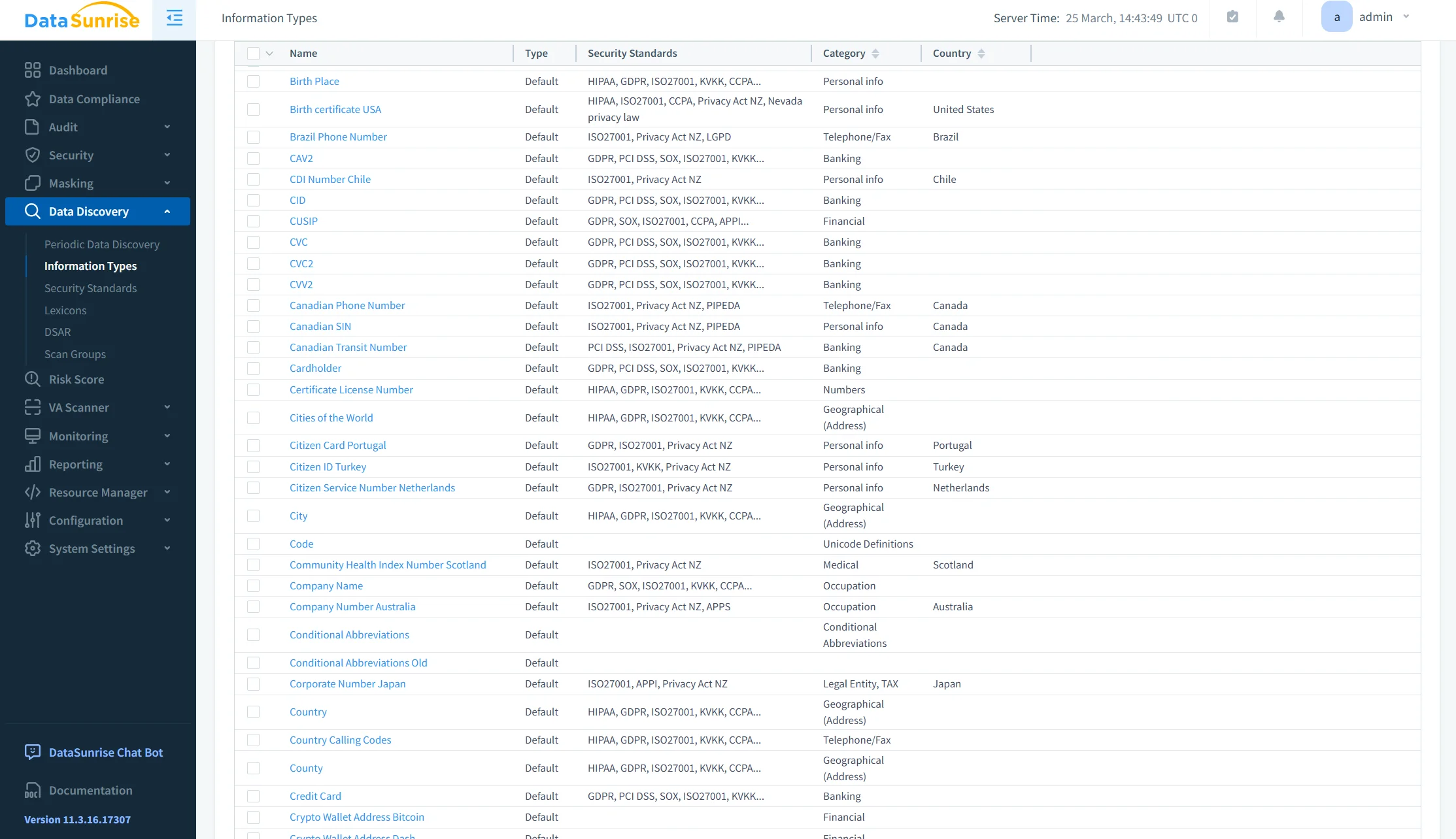
One of the most difficult compliance tasks is determining where regulated information resides before protective policies can be applied. DataSunrise Sensitive Data Discovery scans Amazon DocumentDB collections and identifies potentially sensitive fields based on content, naming patterns, and predefined classification rules.
The platform can detect personally identifiable information, financial records, healthcare data, authentication credentials, and custom business identifiers. Discovery templates support numerous regulatory frameworks, while customizable definitions allow organizations to classify information according to internal governance requirements.
Automated scans can run periodically to identify newly added collections, documents, and sensitive fields. This continuous process helps prevent compliance gaps caused by evolving application schemas and rapidly changing data.
Step 3. Automatically Generate Compliance Policies
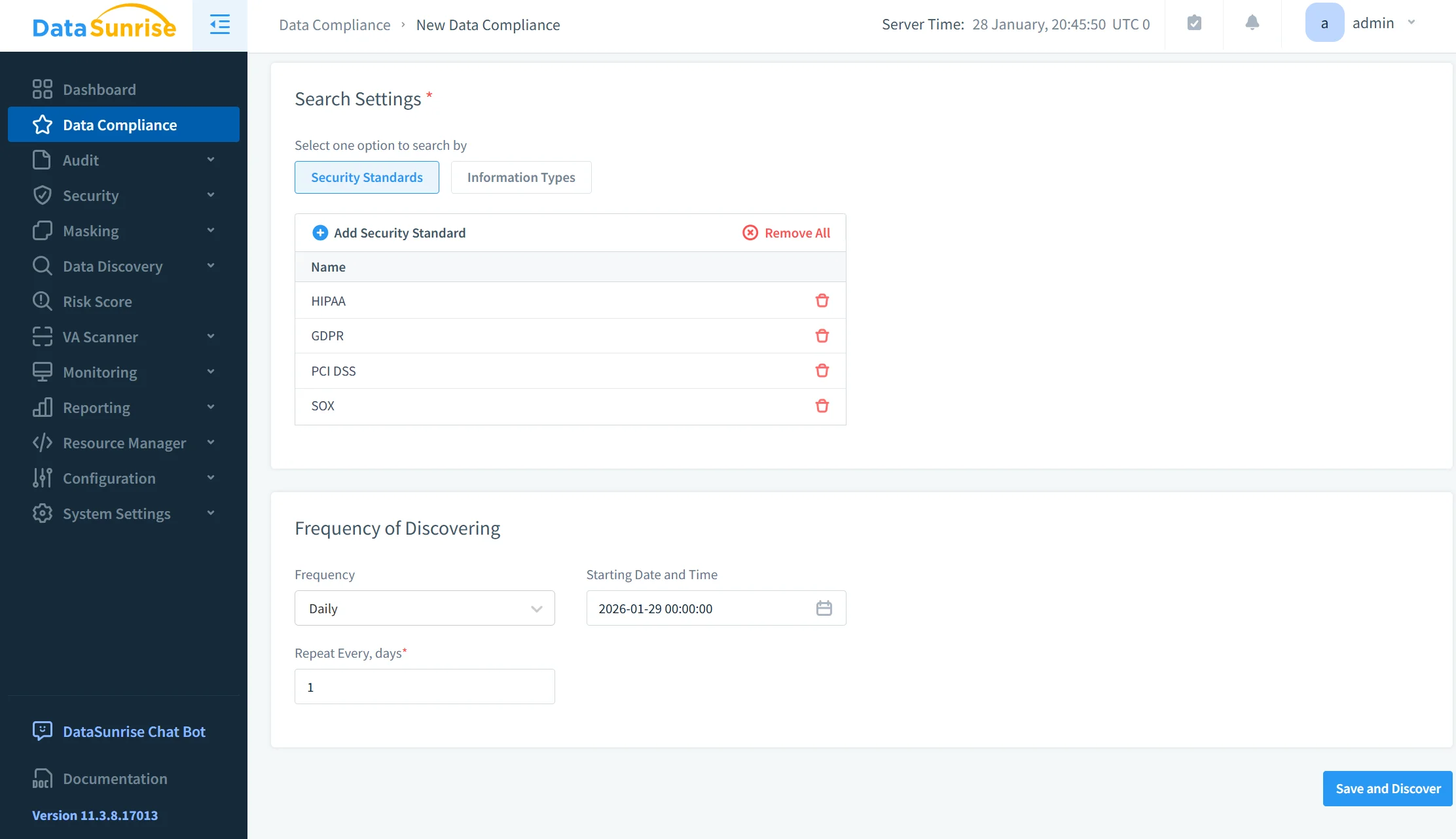
After sensitive information has been discovered, DataSunrise can generate appropriate compliance controls through Compliance Manager. The platform maps identified data categories to relevant regulatory requirements and recommends policies based on the organization’s selected compliance frameworks.
Administrators can apply automatically generated controls for GDPR, HIPAA, PCI DSS, SOX, and CCPA without manually creating hundreds of individual rules. Automatic Policy Generation reduces implementation time while helping teams maintain consistent protection across Amazon DocumentDB and other connected platforms.
Continuous Regulatory Calibration periodically validates existing policies against changing data and compliance requirements. This helps organizations detect policy drift early, update outdated controls, and resolve gaps before they become formal audit findings.
Step 4. Continuously Monitor Database Activity
Compliance requires continuous verification rather than occasional assessments. DataSunrise Database Activity Monitoring records database interactions in real time and provides detailed visibility into how users and applications access Amazon DocumentDB.
Captured events can include user logins, executed operations, administrative actions, failed authentication attempts, privilege changes, and access to sensitive collections. This activity history supports incident investigations, policy verification, and reliable evidence collection through centralized Data Audit capabilities.
Machine Learning Audit Rules analyze activity patterns to identify unusual behavior that may indicate insider threats, compromised credentials, or compliance violations. Security teams can also create new audit, masking, or security rules directly from captured events, reducing response time and strengthening overall compliance posture.
Step 5. Generate Audit-Ready Compliance Reports
Preparing evidence for regulatory audits is often one of the most time-consuming compliance activities. DataSunrise automates this process by consolidating audit logs, policy status, discovered sensitive data, user activity, compliance violations, and security events into structured reports.
Reports can be generated on demand or scheduled automatically through built-in report generation capabilities. This provides consistent evidence for internal assessments, external audits, and regulatory reviews without requiring teams to collect information manually from multiple AWS services.
Organizations can also apply Dynamic Data Masking to prevent unauthorized users from viewing regulated information while preserving normal application workflows.
The result is a centralized compliance management process that reduces administrative effort, improves audit readiness, and provides consistent visibility across Amazon DocumentDB and heterogeneous enterprise environments.
Business Benefits of DataSunrise for Amazon DocumentDB Compliance Management
| Benefit | Business Impact |
|---|---|
| Zero-Touch Compliance Management | Reduces manual compliance work |
| Compliance Autopilot | Accelerates regulatory control deployment |
| Sensitive Data Discovery | Identifies regulated data automatically |
| Continuous Regulatory Calibration | Detects compliance drift early |
| Automatic Policy Generation | Improves policy consistency |
| Database Activity Monitoring | Provides centralized activity visibility |
| Machine Learning Audit Rules | Detects suspicious behavior |
| Dynamic Data Masking | Prevents sensitive data exposure |
| Audit-Ready Reporting | Simplifies evidence collection |
| Unified Compliance Management | Standardizes governance across environments |
| Flexible Deployment Modes | Supports cloud, hybrid, and on-premises setups |
| Reduced Compliance Costs | Lowers operational overhead |
Conclusion
Amazon DocumentDB provides a strong foundation for compliance management through AWS IAM, AWS Config, CloudTrail, CloudWatch, AWS KMS encryption, Amazon VPC, Security Hub, GuardDuty, and AWS Backup. Together, these native services help organizations secure infrastructure, monitor administrative activity, assess configuration changes, and establish essential security policies.
However, effective compliance management extends beyond infrastructure security. Organizations must continuously discover sensitive information, monitor database activity, detect compliance drift, automate policy enforcement, generate audit evidence, and maintain consistent governance across multiple platforms and evolving regulatory requirements. Capabilities such as Sensitive Data Discovery and Database Activity Monitoring help close these operational gaps.
DataSunrise enhances Amazon DocumentDB Compliance Management through Zero-Touch Compliance Management, Compliance Autopilot, Automatic Policy Generation, Continuous Regulatory Calibration, Machine Learning Audit Rules, Dynamic Data Masking, centralized monitoring, and unified policy management. These capabilities significantly reduce manual compliance effort while improving visibility, audit readiness, and regulatory alignment across cloud, hybrid, and heterogeneous environments.
The result is a comprehensive compliance management framework that strengthens data protection, accelerates regulatory readiness, simplifies audits, and enables organizations to maintain continuous compliance throughout the entire Amazon DocumentDB lifecycle.
Protect Your Data with DataSunrise
Secure your data across every layer with DataSunrise. Detect threats in real time with Activity Monitoring, Data Masking, and Database Firewall. Enforce Data Compliance, discover sensitive data, and protect workloads across 50+ supported cloud, on-prem, and AI system data source integrations.
Start protecting your critical data today
Request a Demo Download Now