Amazon DocumentDB Data Compliance Automation
Amazon DocumentDB supports applications that process large volumes of JSON-based operational, customer, financial, and healthcare information. As these environments expand, manually maintaining data compliance controls becomes increasingly difficult.
New collections appear, application roles change, and regulated information moves between development, testing, and production environments. Static policies can quickly become outdated. This creates gaps between documented compliance requirements and actual database configurations.
Amazon DocumentDB Data Compliance Automation addresses this problem through repeatable controls, continuous configuration assessment, automated monitoring, and policy-driven remediation. Native AWS services such as Amazon DocumentDB audit logging and AWS Config provide the foundation for infrastructure-level automation. However, organizations also need to automate sensitive data discovery, database activity analysis, masking, policy creation, and audit evidence collection.
This article examines native Amazon DocumentDB automation capabilities and explains how DataSunrise extends them with autonomous compliance orchestration.
Why Automate Data Compliance for Amazon DocumentDB?
Manual compliance processes usually depend on spreadsheets, periodic reviews, and rules created separately for each environment. This approach becomes fragile when databases change frequently. As organizations deploy new applications, introduce additional collections, and modify user permissions, maintaining consistent compliance manually becomes both time-consuming and prone to human error.
Compliance automation creates a continuous workflow:
- Discover regulated information.
- Evaluate configurations and access controls.
- Apply audit, security, and masking policies.
- Detect deviations from approved requirements.
- Generate alerts and evidence.
- Reassess the environment after every change.
Continuous automation also enables organizations to identify compliance gaps much earlier than periodic manual reviews. By combining automated sensitive data discovery, database activity monitoring, policy enforcement, and automated compliance reporting, security teams gain real-time visibility into their compliance posture while significantly reducing administrative overhead.
This cycle helps organizations support regulatory compliance requirements for GDPR, HIPAA, PCI DSS, SOX, CCPA, and other frameworks.
Automation does not eliminate human oversight. Instead, it removes repetitive work and allows compliance teams to focus on policy decisions, investigations, exceptions, and continuous improvement rather than routine operational tasks.
Native Amazon DocumentDB Data Compliance Automation
AWS provides several managed services that automate infrastructure security, configuration management, and operational governance for Amazon DocumentDB. Together, these services help organizations reduce manual administrative work, continuously evaluate cloud resources, and enforce security best practices across database environments. While these native capabilities primarily focus on infrastructure-level compliance, they form the foundation for building automated compliance workflows.
Automated Event Auditing
Amazon DocumentDB includes native auditing capabilities that record authentication attempts, authorization events, user management operations, and database activities such as DDL and DML commands. When auditing is enabled, audit records are automatically exported as structured JSON documents to Amazon CloudWatch Logs, where they can be retained, searched, filtered, and archived for future investigations or compliance reviews.
Administrators enable auditing by configuring the cluster parameter group and activating CloudWatch log exports for the DocumentDB cluster:
aws docdb modify-db-cluster-parameter-group \
  --db-cluster-parameter-group-name docdb-compliance-parameters \
  --parameters \
  "ParameterName=audit_logs,ParameterValue=enabled,ApplyMethod=immediate"
CloudWatch log exports are then enabled for the cluster:
aws docdb modify-db-cluster \
  --db-cluster-identifier production-documentdb \
  --cloudwatch-logs-export-configuration \
  '{"EnableLogTypes":["audit"]}' \
  --apply-immediately
Once configured, CloudWatch continuously collects audit events without requiring manual log retrieval.
CloudWatch metric filters can automatically detect specific activities, including failed authentication attempts, administrative operations, or other security-related events. These filters generate custom metrics that can trigger CloudWatch alarms, which in turn notify Amazon SNS topics or invoke automated remediation workflows.
For example, the following metric filter counts failed authentication events:
aws logs put-metric-filter \
  --log-group-name "/aws/docdb/production-documentdb/audit" \
  --filter-name "FailedAuthenticationEvents" \
  --filter-pattern '{ $.atype = "authenticate" && $.result != 0 }' \
  --metric-transformations \
  metricName=DocumentDBFailedAuthentication,\
metricNamespace=Compliance/DocumentDB,\
metricValue=1
This event-driven approach enables security teams to respond much faster than traditional manual log reviews.
Automated Configuration Assessment with AWS Config
AWS Config continuously records the configuration state of Amazon DocumentDB resources and evaluates them against managed or custom compliance rules. Instead of relying on periodic infrastructure reviews, AWS Config automatically detects configuration drift whenever protected resources change.
For example, the managed DOCDB_CLUSTER_ENCRYPTED rule verifies that encryption at rest is enabled for every Amazon DocumentDB cluster. Clusters that fail this evaluation are automatically marked as NON_COMPLIANT, allowing administrators to identify issues immediately.
The rule can be deployed using the AWS CLI:
aws configservice put-config-rule \
  --config-rule '{
    "ConfigRuleName": "documentdb-cluster-encryption",
    "Source": {
      "Owner": "AWS",
      "SourceIdentifier": "DOCDB_CLUSTER_ENCRYPTED"
    }
  }'
Organizations can extend these managed rules with custom AWS Lambda evaluations that validate additional compliance requirements, including approved parameter groups, backup retention settings, security group assignments, mandatory audit log exports, authorized AWS KMS keys, required resource tags, and prohibited configuration changes.
AWS Config also supports centralized deployment of compliance rules across multiple AWS accounts, making it easier to maintain consistent governance policies throughout large AWS organizations.
Automated Remediation
Native compliance automation extends beyond detecting problems. AWS Config can automatically initiate remediation workflows whenever a compliance rule fails.
These workflows typically integrate with AWS Systems Manager Automation documents or AWS Lambda functions to perform predefined corrective actions. For example, if audit log exports become disabled, AWS Config can identify the noncompliant resource, invoke an automation document, restore the required CloudWatch log export configuration, notify the security team, and then reevaluate the cluster to confirm that compliance has been restored.
A typical remediation workflow is:
Compliance rule fails
        │
        ▼
AWS Config detects NON_COMPLIANT resource
        │
        ▼
Systems Manager Automation / AWS Lambda
        │
        ▼
Restore required configuration
        │
        ▼
Notify administrators (Amazon SNS)
        │
        ▼
Reevaluate compliance status
Automated remediation is particularly effective for predictable and low-risk configuration issues. More sensitive changes should still require administrative approval before execution to prevent unintended modifications to production environments.
Encryption and Key Management
Amazon DocumentDB protects stored data through encryption at rest using AWS Key Management Service (AWS KMS). Encryption safeguards database storage, indexes, automated backups, snapshots, replicas, and associated storage resources.
Encryption is specified during cluster creation:
aws docdb create-db-cluster \
  --db-cluster-identifier production-documentdb \
  --engine docdb \
  --master-username admin \
  --master-user-password MyPassword123 \
  --storage-encrypted \
  --kms-key-id arn:aws:kms:us-east-1:123456789012:key/example-key
Organizations can further automate encryption governance by using customer-managed KMS keys, scheduled key rotation, key policies, CloudTrail monitoring, automated access revocation procedures, and AWS Config compliance checks.
Because encryption must be enabled when a DocumentDB cluster is created, organizations commonly enforce this requirement through standardized deployment templates and preventive governance policies rather than relying on manual configuration after deployment.
Infrastructure-as-Code Controls
Compliance automation begins before a database is ever deployed. AWS CloudFormation, AWS CDK, and Terraform allow organizations to define compliant Amazon DocumentDB environments using Infrastructure-as-Code (IaC).
Deployment templates can require encryption, CloudWatch audit log exports, backup retention policies, approved parameter groups, deletion protection, networking requirements, and other mandatory security controls before any database resources are provisioned.
A typical CloudFormation template might include:
Resources:
  CompliantDocumentDBCluster:
    Type: AWS::DocDB::DBCluster
    Properties:
      DBClusterIdentifier: production-documentdb
      StorageEncrypted: true
      KmsKeyId: arn:aws:kms:us-east-1:123456789012:key/example-key
      BackupRetentionPeriod: 14
      DeletionProtection: true
      EnableCloudwatchLogsExports:
        - audit
        - profiler
      DBClusterParameterGroupName: documentdb-compliance-parameters
By embedding compliance requirements directly into infrastructure templates, organizations eliminate many configuration inconsistencies between development, testing, and production environments. Infrastructure-as-Code also improves repeatability, simplifies change management, and helps ensure that every newly deployed Amazon DocumentDB cluster follows the same baseline security and compliance standards.
Automated Amazon DocumentDB Compliance with DataSunrise
DataSunrise automates compliance management for Amazon DocumentDB by connecting regulatory requirements directly to database objects, user activity, sensitive data, and security policies. Rather than relying solely on infrastructure-level controls, the platform continuously analyzes database environments, identifies compliance gaps, and automatically applies appropriate audit, masking, and security policies. This approach significantly reduces manual administration while helping organizations maintain continuous alignment with regulations such as GDPR, HIPAA, PCI DSS, SOX, and CCPA through Compliance Manager and centralized database activity monitoring.
Zero-Touch Compliance Deployment
The compliance automation process begins by connecting an Amazon DocumentDB cluster to DataSunrise. After registering the database instance, administrators configure authentication settings, establish a secure connection using TLS, verify connectivity, and select the preferred deployment mode. Once the connection is established, DataSunrise immediately begins monitoring database activity and preparing the environment for automated compliance operations.
Because DataSunrise supports flexible deployment modes for cloud, on-premises, and hybrid environments, organizations can implement centralized compliance management without modifying existing applications or redesigning their infrastructure.
Automated Sensitive Data Discovery
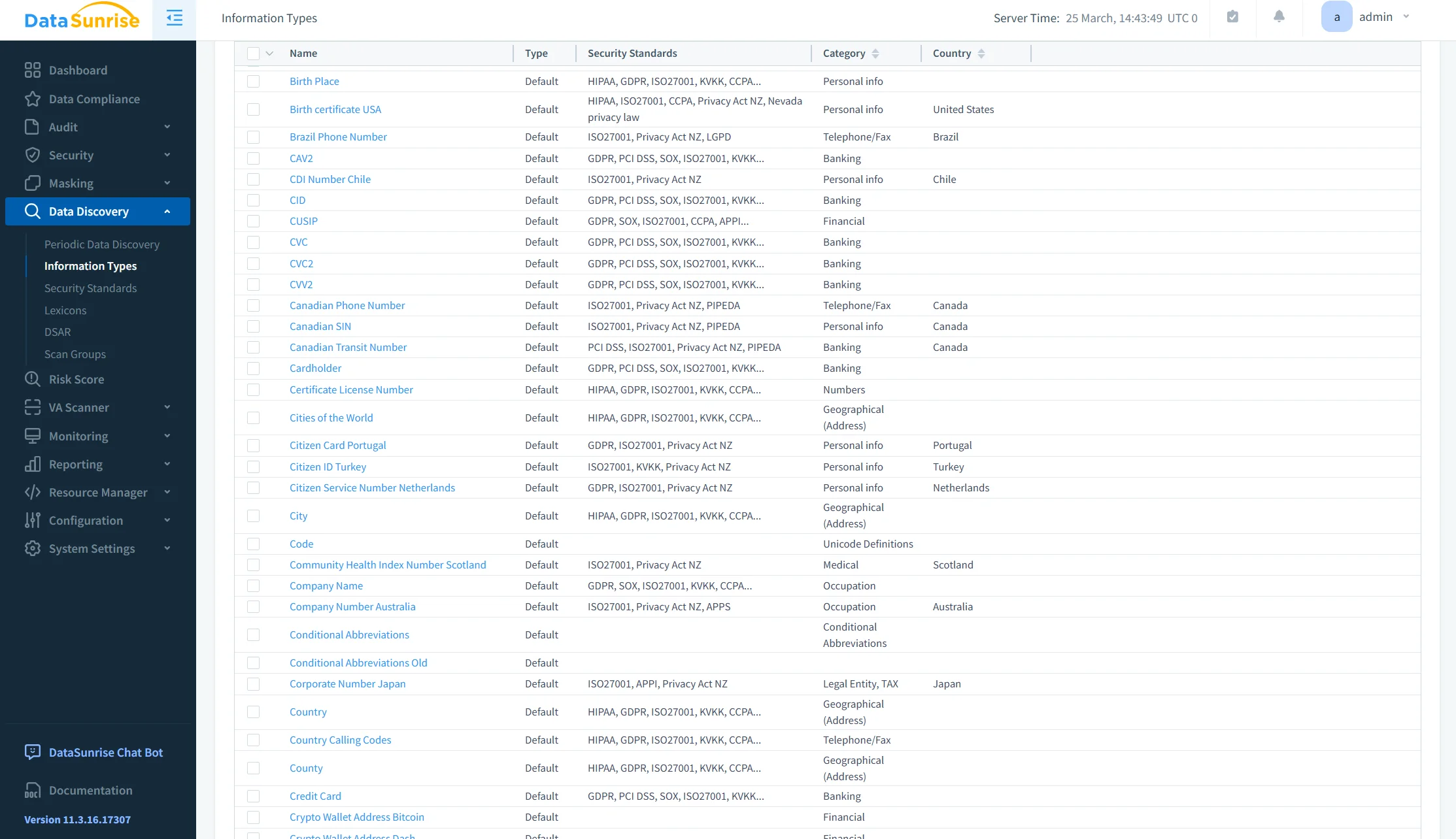
DataSunrise continuously scans Amazon DocumentDB collections using Sensitive Data Discovery to identify regulated and sensitive information. Instead of relying on manual classification, the platform automatically detects personally identifiable information (PII), financial records, healthcare information, payment card data, authentication credentials, and organization-specific sensitive data patterns.
Discovery jobs can run on a scheduled basis, allowing newly created collections and newly introduced document fields to be identified automatically. This capability is particularly valuable for JSON-based databases where document structures frequently evolve without formal schema migrations.
Once sensitive information has been identified, administrators can immediately generate audit, masking, and security policies for the discovered database objects.
Compliance Autopilot
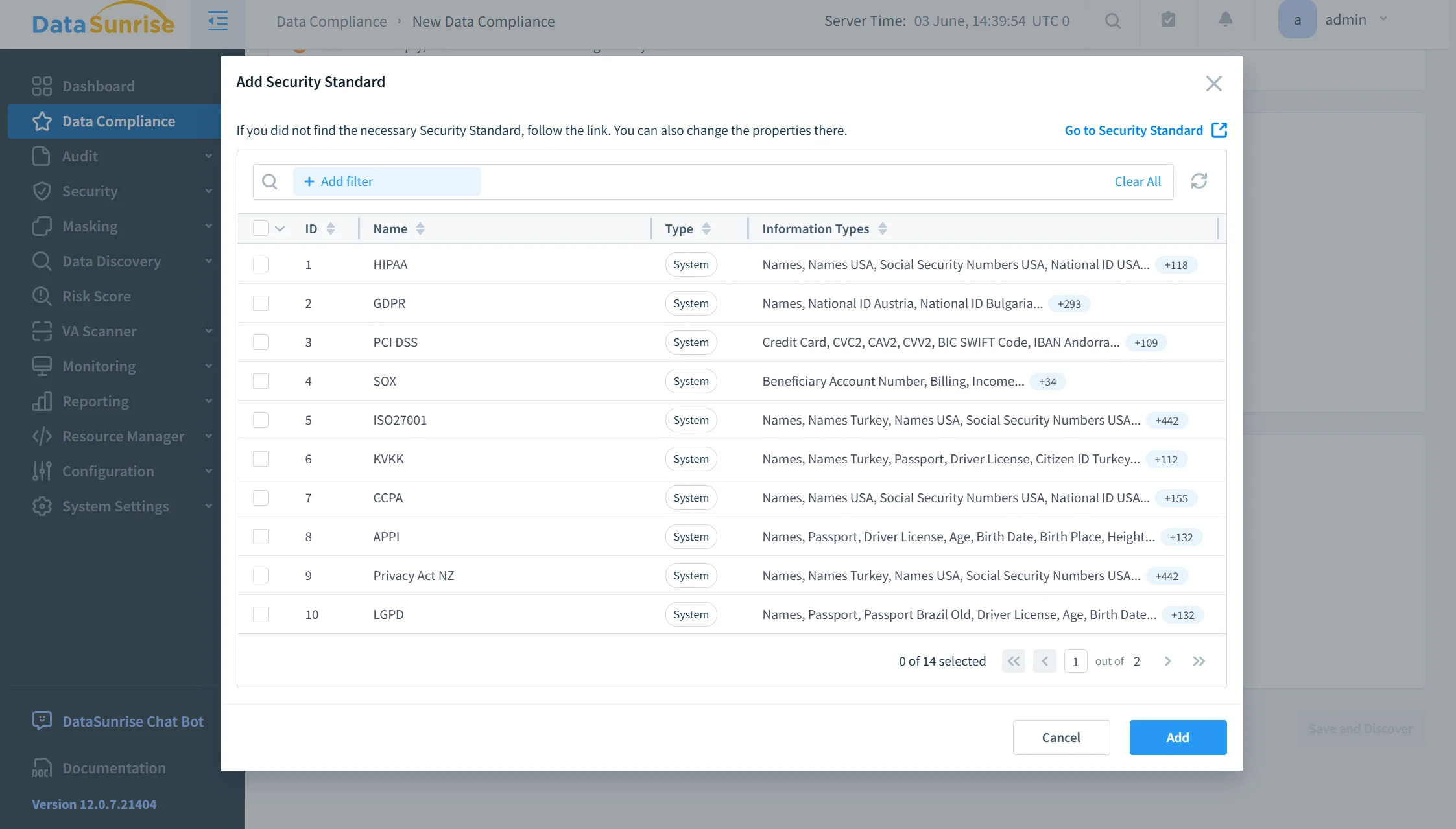
Compliance Autopilot automatically maps discovered sensitive information to applicable regulatory frameworks, including GDPR, HIPAA, PCI DSS, SOX, CCPA, and other industry standards. Instead of manually interpreting every regulatory requirement, organizations can rely on predefined compliance mappings that continuously evaluate database protection.
The platform coordinates sensitive data classification, database activity monitoring, masking policies, security controls, automated reporting, and recurring compliance assessments as part of a unified workflow. As a result, compliance becomes an ongoing operational process rather than a periodic audit exercise.
Automatic Policy Generation
After sensitive information is identified, DataSunrise automatically generates security policies based on discovered data and selected regulatory requirements. For example, when payment card information is detected inside an Amazon DocumentDB collection, the platform can automatically create audit rules, dynamic data masking policies, security restrictions, compliance reporting configurations, and monitoring rules for suspicious activity.
This automated policy generation minimizes repetitive manual configuration while maintaining consistent protection across multiple collections and environments.
Continuous Regulatory Calibration
Database environments constantly evolve as applications introduce new collections, users receive additional privileges, and business requirements change. Continuous Regulatory Calibration periodically evaluates the current environment against established compliance policies to identify emerging compliance gaps.
The platform continuously detects newly created collections, recently discovered sensitive fields, modified user permissions, missing audit rules, disabled security policies, unusual database activity, and changes in regulatory mappings. By continuously reassessing compliance posture, organizations can identify configuration drift long before scheduled compliance audits occur while supporting broader regulatory compliance initiatives.
Machine Learning Audit Rules
Traditional audit rules monitor predefined events and database operations. DataSunrise extends this capability through Machine Learning Audit Rules that analyze user behavior and identify unusual activity patterns.
Behavioral analysis can detect service accounts accessing unfamiliar collections, abnormal query volumes, administrative operations performed outside normal business hours, unexpected bulk retrieval of sensitive information, and database access patterns that differ significantly from historical behavior. These intelligent rules complement conventional database activity monitoring by helping security teams prioritize incidents that may indicate compromised credentials or insider threats.
Dynamic Data Masking
Protecting sensitive information requires more than simply identifying it. DataSunrise Dynamic Data Masking automatically replaces confidential values with masked data according to user identity, application, network location, assigned role, or session context.
Authorized applications continue accessing the original information, while unauthorized users receive masked values without modifying the underlying documents stored in Amazon DocumentDB. This approach enforces the Principle of Least Privilege while preserving application compatibility and normal business operations.
Automated Reporting and Evidence Collection
DataSunrise automatically generates compliance evidence using collected audit events, discovery results, security policies, and monitoring activities. Organizations can schedule recurring compliance reports, export evidence in formats such as PDF or CSV, document access to regulated collections, verify masking policies, track configuration changes, and prepare audit documentation for both internal assessments and external regulatory reviews using automated report generation capabilities.
By consolidating audit evidence into a centralized reporting platform, DataSunrise significantly reduces the time required to collect information from CloudWatch, AWS Config, IAM, application logs, and multiple independent monitoring systems, allowing compliance teams to produce audit-ready documentation with substantially less manual effort.
Native AWS Automation vs. DataSunrise
| Capability | Native AWS Services | DataSunrise |
|---|---|---|
| Configuration Compliance | AWS Config, Security Hub | Centralized compliance management |
| Audit Monitoring | DocumentDB audit logs, CloudWatch | Granular database activity monitoring |
| Sensitive Data Discovery | Additional services or custom workflows required | Automated Sensitive Data Discovery |
| Policy Automation | Manual configuration or custom code | Automatic Policy Generation |
| Compliance Monitoring | Infrastructure-focused | Continuous Regulatory Calibration |
| Dynamic Data Protection | Not available natively | Dynamic Data Masking |
| Audit Reporting | Distributed across AWS services | Centralized audit-ready reporting |
| Multi-Platform Governance | AWS environments only | Unified compliance across heterogeneous databases |
Conclusion
Amazon DocumentDB provides a capable foundation for data compliance automation through event auditing, CloudWatch Logs, AWS Config, Security Hub, AWS KMS, CloudFormation, Lambda, and automated backup services. Together, these technologies help organizations standardize infrastructure configurations, detect deviations, collect operational evidence, and trigger remediation workflows.
However, infrastructure automation cannot independently classify sensitive document fields, correlate database activity with regulatory requirements, generate data-level protection policies, or mask regulated values.
DataSunrise extends Amazon DocumentDB Data Compliance Automation through Sensitive Data Discovery, Compliance Autopilot, Automatic Policy Generation, Continuous Regulatory Calibration, Machine Learning Audit Rules, Dynamic Data Masking, centralized monitoring, and automated reporting.
The result is a continuous compliance framework that reduces manual effort, detects emerging gaps, protects sensitive information, and improves audit readiness across Amazon DocumentDB and heterogeneous data environments. Learn more about the DataSunrise platform or schedule a live demo to see automated compliance in action.
Protect Your Data with DataSunrise
Secure your data across every layer with DataSunrise. Detect threats in real time with Activity Monitoring, Data Masking, and Database Firewall. Enforce Data Compliance, discover sensitive data, and protect workloads across 50+ supported cloud, on-prem, and AI system data source integrations.
Start protecting your critical data today
Request a Demo Download Now