Sensitive Data Protection in Microsoft SQL Server
Sensitive data protection in Microsoft SQL Server is no longer just a compliance checkbox someone waves around during quarterly panic rituals. Modern SQL Server environments process financial records, authentication data, healthcare information, intellectual property, and operational telemetry across cloud, hybrid, and on-premise infrastructures simultaneously. One badly secured query window and suddenly your customer database is starring in somebody else’s ransomware documentary.
Microsoft SQL Server provides several native security capabilities for protecting sensitive information, including encryption, dynamic masking, row-level security, auditing, and access controls. However, enterprise environments usually require more than isolated configuration features scattered across SSMS tabs like forgotten landmines.
Organizations now need centralized visibility, Continuous Compliance Posture monitoring, autonomous policy orchestration, and real-time protection capable of scaling across structured, semi-structured, and unstructured data environments.
Modern security strategies also rely heavily on continuous data discovery and centralized database activity monitoring to identify sensitive assets before attackers, insider threats, or compliance auditors do it for them first. Because nothing says “mature security posture” quite like discovering an unprotected customer export sitting in a forgotten staging database from 2019.
Microsoft itself recommends layered protection approaches combining encryption, auditing, masking, and least-privilege access controls for SQL Server environments. Additional guidance from the official Microsoft SQL Server security best practices and NIST security framework recommendations reinforces the importance of continuous monitoring, policy enforcement, and proactive threat detection across enterprise infrastructures.
This article explores native Microsoft SQL Server sensitive data protection capabilities and demonstrates how DataSunrise extends them through Compliance Autopilot, Zero-Touch Data Masking, ML Audit Rules, and Unified Security Framework integration.
Importance of Sensitive Data Protection
Sensitive data protection in Microsoft SQL Server directly affects operational stability, regulatory compliance, financial risk, and organizational reputation. Once attackers gain access to exposed databases, they rarely stop at simply stealing records. Modern breaches often escalate into ransomware deployment, privilege escalation, lateral movement across infrastructure, and large-scale exfiltration of customer or business-critical information. Delightful little chaos festivals, really.
SQL Server environments commonly store:
- Personally identifiable information (PII)
- Payment card data
- Healthcare records
- Authentication credentials
- Financial transactions
- Internal business analytics
- API tokens and service accounts
Without proper controls, even legitimate internal users can accidentally expose or misuse sensitive information. A reporting analyst exporting raw production datasets into unsecured spreadsheets has caused more compliance disasters than many external attackers ever will. Human creativity remains undefeated when it comes to inventing new failure modes.
Strong sensitive data protection strategies help organizations:
- Reduce the likelihood of data breaches
- Enforce least-privilege access policies
- Prevent unauthorized data exposure
- Detect abnormal database behavior in real time
- Simplify audit preparation
- Maintain regulatory compliance
- Protect customer trust and brand reputation
Regulatory frameworks such as GDPR, HIPAA, and PCI DSS now require organizations to implement strict controls around sensitive data access, retention, auditing, and masking. Failure to comply can result in financial penalties, legal exposure, operational disruption, and mandatory breach disclosure requirements that executives tend to describe as “suboptimal.”
Modern infrastructures also introduce additional complexity through:
- Hybrid cloud deployments
- Multi-database ecosystems
- Shadow IT environments
- AI and analytics pipelines
- Third-party integrations
- Remote administrative access
As a result, protecting sensitive data can no longer rely on isolated encryption settings or static access rules alone. Organizations increasingly require centralized compliance management, adaptive data security, autonomous policy enforcement, and continuous monitoring capable of operating across structured, semi-structured, and unstructured environments simultaneously.
This is where modern platforms like DataSunrise extend SQL Server beyond native protection capabilities through Compliance Autopilot, ML-driven monitoring, Zero-Touch Data Masking, and Unified Security Framework integration. Because manually maintaining hundreds of disconnected security rules across hybrid infrastructure is exactly the kind of life-shortening experience nobody asked for.
Native Sensitive Data Protection Capabilities in Microsoft SQL Server
Microsoft SQL Server provides multiple native security mechanisms designed to reduce unauthorized access to sensitive information, protect stored data, and enforce access control policies at different layers of the database engine.
These capabilities include dynamic masking, encryption, row-level access filtering, and auditing components that support compliance and operational security requirements.
Dynamic Data Masking
Dynamic Data Masking (DDM) allows SQL Server to obfuscate sensitive values during query execution without modifying the underlying stored data. The masking operation is applied dynamically at the presentation layer based on user permissions.
The following example masks email addresses and salary values:
CREATE TABLE Employees (
    EmployeeID INT PRIMARY KEY,
    FullName NVARCHAR(100),
    Email NVARCHAR(255) MASKED WITH (FUNCTION = 'email()'),
    Salary DECIMAL(10,2) MASKED WITH (FUNCTION = 'default()')
);
Insert sample records:
INSERT INTO Employees VALUES
(1, 'Alice Carter', '[email protected]', 120000),
(2, 'Bob Smith', '[email protected]', 95000);
Query the table using a non-privileged account:
SELECT * FROM Employees;
Example output:
| EmployeeID | FullName | Salary | |
|---|---|---|---|
| 1 | Alice Carter | [email protected] | 0.00 |
| 2 | Bob Smith | [email protected] | 0.00 |
Dynamic masking is commonly used in reporting systems, development environments, support workflows, and shared operational dashboards where users do not require direct access to original values.
The feature operates at the query-result layer and allows SQL Server to dynamically replace sensitive output based on assigned permissions. This helps reduce accidental exposure of confidential information while preserving application functionality.
However, Dynamic Data Masking has several architectural limitations. Policies are defined directly at the schema level, making centralized management across multiple SQL Server environments difficult. The masking logic remains platform-specific, privileged users can bypass restrictions, and the feature does not encrypt stored data internally.
Official reference:
Transparent Data Encryption (TDE)
Transparent Data Encryption (TDE) protects SQL Server databases at rest by encrypting physical database files, transaction logs, and backups.
TDE performs automatic page-level encryption and decryption during disk I/O operations, helping reduce the risk of unauthorized access to database files or stolen backup media.
Enable TDE:
CREATE MASTER KEY ENCRYPTION BY PASSWORD = 'StrongPassword123!';

CREATE CERTIFICATE TDECert
WITH SUBJECT = 'TDE Certificate';

CREATE DATABASE ENCRYPTION KEY
WITH ALGORITHM = AES_256
ENCRYPTION BY SERVER CERTIFICATE TDECert;

ALTER DATABASE SensitiveDB
SET ENCRYPTION ON;
After activation, SQL Server transparently encrypts database storage without requiring changes at the application layer.
Transparent Data Encryption primarily protects against offline threats. It reduces exposure in scenarios involving unauthorized backup access, physical disk compromise, stolen database files, or direct storage-level access to SQL Server data files.
However, TDE does not control visibility of data during active sessions. Users with valid database permissions can continue accessing decrypted records normally after authentication.
Additional operational limitations include the absence of activity monitoring, lack of query-level filtering, and the requirement for secure encryption key lifecycle management.
Official reference:
Row-Level Security
Row-Level Security (RLS) restricts access to specific rows using security predicates evaluated during query execution.
The feature allows SQL Server to apply logical data isolation policies directly inside the database engine.
Example predicate function:
CREATE FUNCTION dbo.SecurityPredicate(@Department AS sysname)
RETURNS TABLE
WITH SCHEMABINDING
AS
RETURN SELECT 1 AS Result
WHERE @Department = USER_NAME();
Apply the security policy:
CREATE SECURITY POLICY DepartmentFilter
ADD FILTER PREDICATE dbo.SecurityPredicate(Department)
ON dbo.EmployeeRecords
WITH (STATE = ON);
Once enabled, SQL Server automatically filters query results according to the predicate logic associated with the current user context.
Row-Level Security is commonly implemented in multi-tenant SaaS environments, department-level isolation models, regional access segmentation, and least-privilege access architectures where different users must access different subsets of the same table.
The feature simplifies logical segregation inside shared database environments. However, policy management complexity increases significantly in infrastructures with nested permission hierarchies, dynamic mappings, and large numbers of applications or tenants.
Official reference:
SQL Server Auditing
SQL Server Audit provides native activity monitoring capabilities for tracking access attempts, schema changes, administrative actions, and database operations.
Audit records can be written to files, Windows Security Logs, or Application Logs depending on deployment requirements.
Create a server audit object:
CREATE SERVER AUDIT SensitiveAudit
TO FILE (
    FILEPATH = 'C:\SQLAudit\'
);

ALTER SERVER AUDIT SensitiveAudit
WITH (STATE = ON);
Create a database audit specification:
CREATE DATABASE AUDIT SPECIFICATION SensitiveAuditSpec
FOR SERVER AUDIT SensitiveAudit
ADD (SELECT, INSERT, UPDATE, DELETE
ON dbo.Customers BY PUBLIC);

ALTER DATABASE AUDIT SPECIFICATION SensitiveAuditSpec
WITH (STATE = ON);
Review audit records:
SELECT *
FROM sys.fn_get_audit_file
('C:\SQLAudit\*.sqlaudit', DEFAULT, DEFAULT);
SQL Server Audit supports monitoring of authentication events, DDL operations, DML activity, permission modifications, failed access attempts, and administrative actions.
The feature provides foundational visibility into database activity and supports compliance requirements associated with regulations such as GDPR, HIPAA, PCI DSS, and SOX.
However, large-scale audit deployments introduce additional operational overhead. Organizations must manage audit log growth, correlate events across multiple SQL Server instances, maintain storage retention policies, and manually investigate suspicious behavior.
Native auditing also provides limited behavioral analytics and minimal anomaly detection capabilities, making centralized monitoring increasingly difficult in complex enterprise environments.
Autonomous Sensitive Data Protection with DataSunrise
DataSunrise deploys Autonomous Compliance Orchestration and Zero-Touch Data Masking to deliver centralized sensitive data protection across Microsoft SQL Server environments with minimal operational overhead.
Unlike isolated native controls that require continuous manual administration, DataSunrise provides Continuous Regulatory Calibration across structured, semi-structured, and unstructured environments, including cloud storage platforms, enterprise file systems, and OCR-scanned image content. The platform centralizes policy enforcement, compliance monitoring, and audit visibility while reducing the complexity associated with managing distributed SQL Server infrastructures.
Connecting SQL Server to DataSunrise
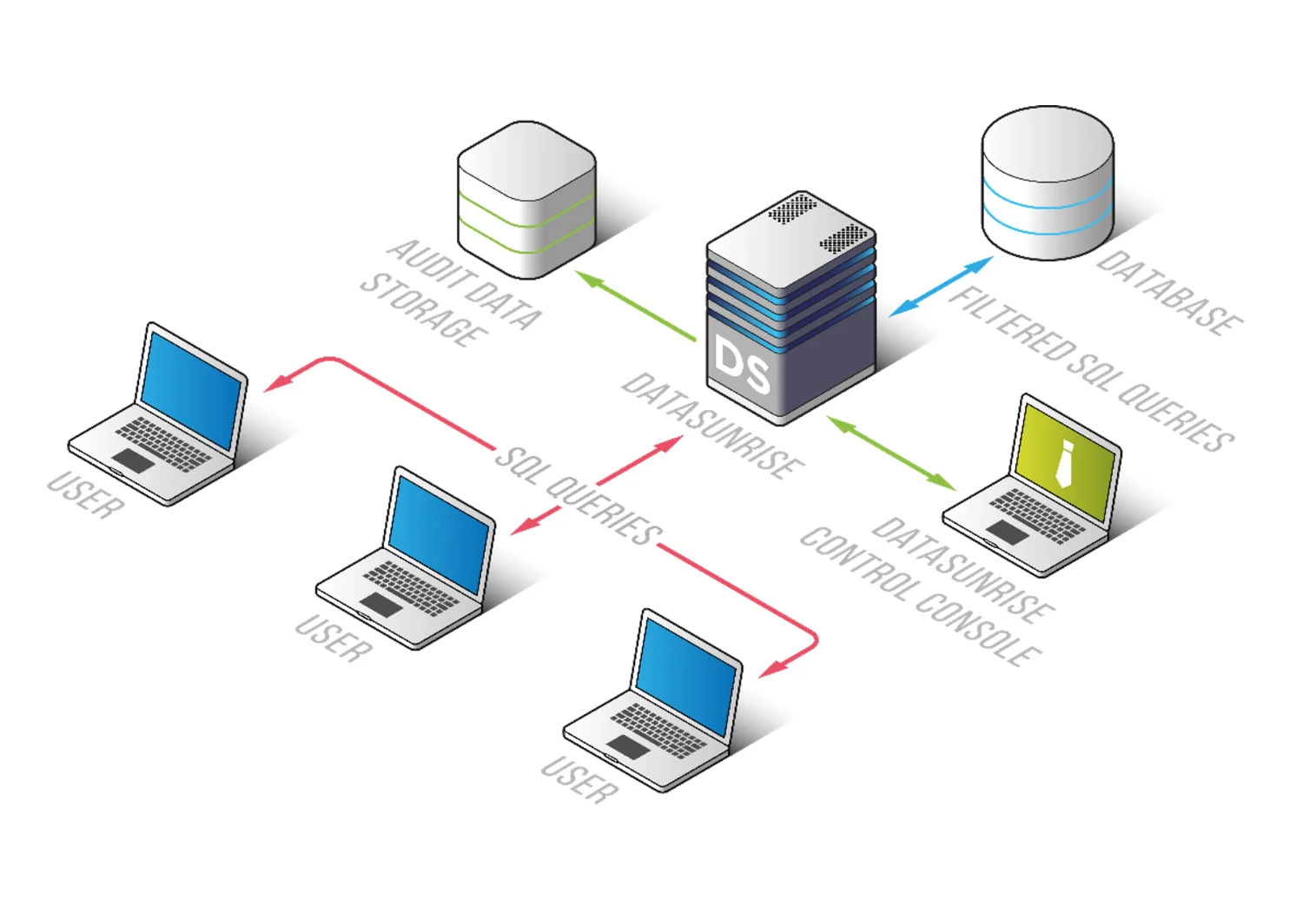
Administrators can connect Microsoft SQL Server instances to DataSunrise through Proxy, Sniffer, or Native Log Trailing deployment modes depending on infrastructure and monitoring requirements.
This architecture allows organizations to maintain centralized policy management, cross-database visibility, unified audit collection, real-time activity monitoring, and vendor-agnostic protection across heterogeneous environments.
DataSunrise supports deployment in cloud, hybrid, and on-premise infrastructures without requiring application modifications or database redesign. This simplifies integration into existing SQL Server ecosystems while preserving operational continuity.
Useful references:
Sensitive Data Discovery and Classification
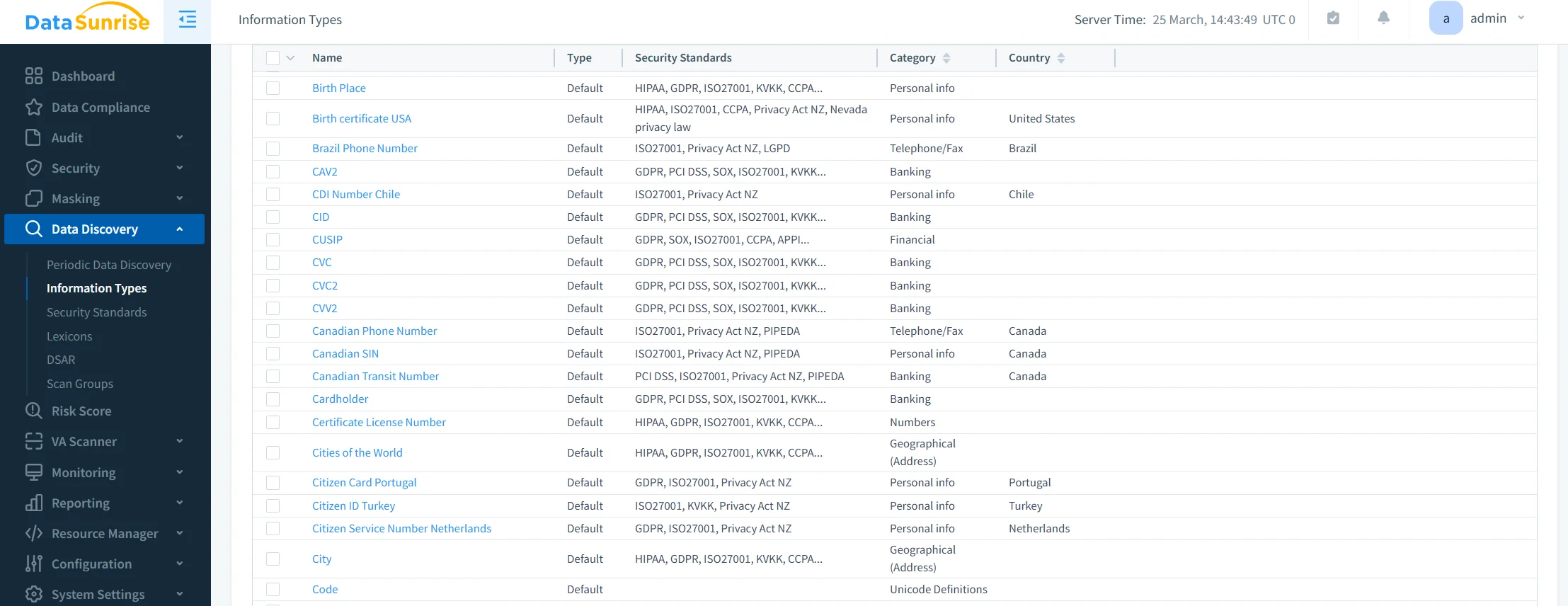
DataSunrise automatically discovers sensitive information using NLP-based data discovery, machine learning classification models, pattern analysis, and OCR Image Scanning technologies.
The platform identifies regulated and business-critical information across SQL Server databases and connected storage environments, including personally identifiable information (PII), protected health information (PHI), PCI-regulated payment data, financial identifiers, authentication credentials, and internal business records.
Automated discovery processes continuously scan environments for newly introduced sensitive datasets, configuration drift, and emerging compliance risks. This allows organizations to maintain updated visibility into sensitive data exposure across rapidly changing infrastructures.
Related resources:
Dynamic and Static Masking Policies
DataSunrise extends Microsoft SQL Server masking capabilities through centralized No-Code Policy Automation and Surgical Precision Masking policies.
The platform supports role-aware masking, conditional masking logic, cross-database masking consistency, real-time policy updates, and orchestration of both dynamic and static masking workflows.
Unlike native SQL Server masking mechanisms that remain tightly coupled to schema definitions, DataSunrise externalizes masking policies from the database structure itself. This simplifies policy administration across multiple SQL Server instances and improves governance consistency in enterprise-scale environments.
References:
ML Audit Rules and Behavior Analytics
DataSunrise enhances native SQL Server auditing through ML Audit Rules and User Behavior Monitoring capabilities.
The platform analyzes database activity in real time to identify suspicious patterns such as privilege escalation attempts, abnormal query behavior, excessive data extraction, insider threats, SQL injection activity, and compliance drift.
Behavioral analytics and machine learning models help security teams detect anomalies that are difficult to identify through traditional rule-based auditing alone. Real-Time Notifications integrate with SIEM platforms, Slack, and Microsoft Teams to accelerate incident response workflows and improve operational visibility.
Resources:
Compliance Automation for Microsoft SQL Server
DataSunrise Compliance Autopilot simplifies regulatory alignment for frameworks including GDPR, HIPAA, PCI DSS, SOX, SOC 2, ISO 27001, and NIST.
The platform automates compliance policy generation, audit-ready reporting, Continuous Compliance Posture monitoring, compliance drift detection, and evidence collection processes required during regulatory assessments.
By centralizing compliance operations, DataSunrise reduces the administrative overhead associated with maintaining manual reporting workflows across multiple SQL Server environments. Security and compliance teams can generate audit evidence, monitor policy violations, and maintain regulatory visibility through a unified management interface.
Compliance resources:
Business Impact of Sensitive Data Protection
Effective sensitive data protection directly affects operational resilience, regulatory stability, and long-term business continuity across Microsoft SQL Server environments. As organizations expand into hybrid infrastructures, cloud platforms, analytics systems, and analytics workflows, centralized data security becomes essential for maintaining consistent protection.
| Benefit | Business Impact |
|---|---|
| Autonomous Protection | Reduces manual security operations |
| Continuous Monitoring | Improves incident detection speed through database activity monitoring |
| Compliance Automation | Accelerates audit preparation with centralized compliance management |
| Centralized Governance | Simplifies policy management |
| Real-Time Threat Detection | Minimizes breach exposure |
| Cross-Platform Coverage | Standardizes security controls |
| Dynamic Masking | Reduces accidental exposure risks through dynamic data masking |
| ML Analytics | Detects insider threats earlier with user behavior analytics |
Conclusion
Sensitive data protection in Microsoft SQL Server requires more than isolated encryption settings and manually maintained audit policies. Modern infrastructures demand centralized governance, adaptive monitoring, autonomous compliance management, and scalable protection capable of operating across cloud, hybrid, and heterogeneous environments.
Native SQL Server capabilities provide an important baseline. However, maintaining consistent protection and compliance across enterprise-scale deployments using fragmented native controls alone quickly becomes operationally inefficient.
DataSunrise transforms sensitive data protection into an autonomous enterprise security architecture through Compliance Autopilot, Zero-Touch Data Masking, Intelligent Policy Orchestration, ML Audit Rules, and Unified Security Framework integration.
Unlike solutions that require constant tuning and disconnected workflows, DataSunrise delivers Continuous Compliance Alignment and centralized protection across Microsoft SQL Server ecosystems while significantly reducing administrative effort and compliance gaps through unified database activity monitoring, automated compliance management, advanced dynamic data masking, intelligent data discovery, and centralized data security policy enforcement.
The platform combines enterprise-grade automation with the fine-grained controls security teams actually need while maintaining operational scalability across modern SQL Server infrastructures.
Protect Your Data with DataSunrise
Secure your data across every layer with DataSunrise. Detect threats in real time with Activity Monitoring, Data Masking, and Database Firewall. Enforce Data Compliance, discover sensitive data, and protect workloads across 50+ supported cloud, on-prem, and AI system data source integrations.
Start protecting your critical data today
Request a Demo Download Now